AI sales channels with Shopware: What merchants need to know
Shopware opens product data and buying journeys to ChatGPT and other AI agents. The benefits, limitations, availability, and path to a first Agentic Commerce channel.

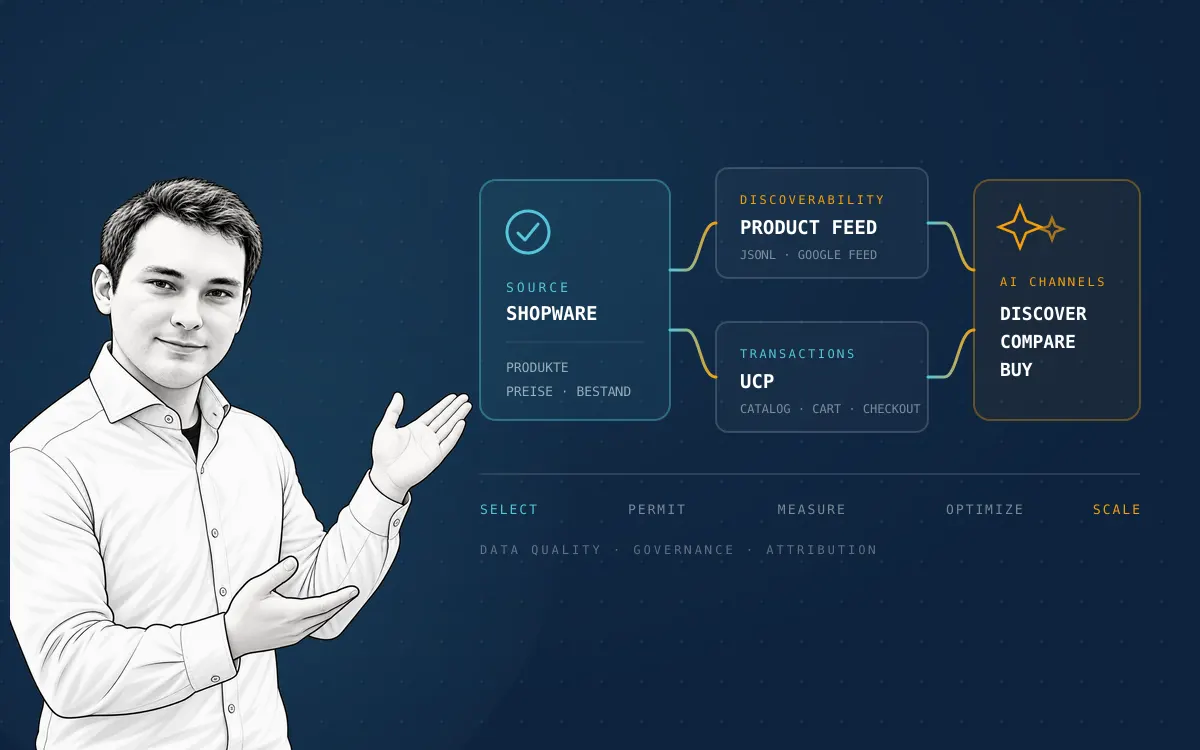
With its free beta extension Agentic Commerce, Shopware generates structured product feeds for OpenAI and Google Merchant Center and can expose cart, checkout, and orders to AI agents in a controlled way through the Universal Commerce Protocol (UCP). The extension has been available since 9 June 2026 for Shopware 6.5 to 6.7; the ChatGPT Marketplace is not yet open to European merchants.
The context: product discovery no longer has to begin on Google, Amazon, or the merchant's storefront. Shoppers ask ChatGPT, Gemini, or specialist shopping agents: “Which running shoe suits wide feet and costs less than €150?” The answer is formed where buying intent is expressed. If a merchant's catalogue does not appear there, the customer relationship may be lost before the traditional funnel even begins. The extension is therefore more than another product export — but it is not a turnkey revenue channel with guaranteed results.
What an AI sales channel actually is
An AI sales channel comprises two distinct stages that the term currently tends to blur: discoverability – an AI system can find, understand, and recommend products through a structured feed – and agentic commerce, where a compatible agent acts within exposed boundaries through an interface such as UCP, from cart to order.
Discoverability: An AI system can find, understand, and recommend a product in its response. Shopware provides a structured product feed for this purpose. The current extension creates a JSONL feed following the OpenAI specification and a feed for Google Merchant Center. Prices, availability, variants, and product links come from the assigned storefront sales channel.
Agentic Commerce: A compatible agent can do more than read; it can act within clearly defined boundaries. UCP exposes capabilities such as catalogue browsing, cart, discounts, checkout, and orders individually. The agent becomes an additional interface in front of Shopware, while Shopware remains the system of record for products, prices, and orders.
This distinction matters. A feed improves the chance of appearing in an AI response. Only a connected agent with the appropriate permissions can advance the buying journey itself. “Selling in ChatGPT” is therefore not a single checkbox.
The benefits for Shopware merchants
Four benefits carry the business case: visibility closer to concrete buying intent, one governed standard access point instead of many one-off integrations, measurement through affiliate and campaign codes directly in Shopware, and full merchant control over catalogue, prices, and exposed capabilities. None of them appears automatically – all four depend on the quality of the product data.
1. Visibility closer to buying intent
AI searches are often more detailed than conventional keywords. Shoppers describe use case, budget, material, exclusions, and delivery needs in one request. Well-structured product data can surface precisely when a need is already concrete, instead of after multiple search and filter rounds. How strongly a stated purchase intent drives conversion — in your own shop's search box too — is covered in our post Search in e-commerce: why your shop needs a search that actually finds.
2. A governed access point instead of many one-off integrations
The Agentic Commerce sales channel brings catalogue selection, feed configuration, and tracking together. UCP applies the same idea to transactions: compatible agents use a standard interface while the merchant decides which capabilities each sales channel exposes. This reduces integration work as more AI surfaces adopt the same standard.
3. Measurement within Shopware
Affiliate and campaign codes attribute visits and orders to the channel. Shopware reports referred orders, new customers, and revenue. This turns “AI is a trend” into a testable hypothesis: Which platform delivers qualified traffic, which products work, and what does the channel cost to operate?
4. The merchant retains selection and rules
A dynamic product group defines which products are exported at all. Language, currency, domain, and customer group derive from the selected storefront sales channel. With UCP, read and transaction capabilities can be exposed separately. For B2B, customer-specific pricing, or consultative products, that control is more important than maximum reach.
What must be settled before launch
Five points must be settled before launch: product data quality, a dependable source for price and stock, machine-readable legal information, transaction capabilities granted on a least-privilege basis, and dedicated KPIs for the shifting customer journey. Because the technical channel amplifies the quality of the underlying data — good or bad.
Product data becomes the sales interface. Colour, size, sizing system, material, gender, and age group need consistent properties and mappings to target fields. Free text, internal abbreviations, and inconsistent variant names otherwise produce poor recommendations. Images, GTINs, brands, lead times, and availability belong in the same data quality audit.
Price and stock need a dependable source. An agent is only as current as the feed interval, ERP/PIM synchronisation, and Shopware index. Promotional pricing, scarce inventory, and customer-specific terms require a clear rule for which value is authoritative at each stage.
Legal information must be machine-readable and reachable. The OpenAI feed requires a public returns-policy URL. The project should also review privacy, price display, cancellation rights, mandatory product information, and the terms of each AI platform. A new interface does not transfer the merchant's responsibility.
Transaction capabilities are a security decision. Catalogue access is less sensitive than discount, checkout, or order access. UCP capabilities should follow least privilege, begin in a test environment, and be monitored with logs, rate limits, and alerts. B2B journeys additionally require sound identity, approval thresholds, customer pricing, and purchasing permissions.
The customer journey moves. When advice and selection happen in an external interface, brand storytelling, cross-selling, and consent flows are partly decoupled. The channel therefore needs its own KPIs: not just revenue, but return rate, margin, share of new customers, support effort, and data quality.
When is Agentic Commerce available?
As of 17 August 2026: Shopware published the extension in the Shopware Store on 9 June 2026. The current version 1.2.0 is free, remains in beta, and is listed as compatible with Shopware 6.5, 6.6, and 6.7. Shopware plans to continue expanding the beta during 2026, so behaviour and interfaces can still change.
For European merchants, availability has two layers:
- Available today: Install the extension, configure the product feed, connect Google Merchant Center, prepare a UCP profile, and test compatible agents in a controlled environment.
- Still restricted: According to the Shopware documentation, registration for the ChatGPT Marketplace is currently available only to US merchants. Europe is marked as “coming soon,” without a committed date.
- Provider-dependent: Whether products actually appear in ChatGPT, Gemini, Perplexity, PayPal, or another interface — and which transactions are possible — also depends on access granted by that platform, not only on the Shopware configuration.
The consequence is straightforward: European merchants can and should begin the technical and editorial preparation now. That preparation does not yet equal a fully rolled-out additional revenue channel.
How to set up the first AI sales channel
Seven steps get the channel live: protect the existing shop, choose a pilot catalogue, configure the Agentic Commerce sales channel, connect Google Merchant Center and the OpenAI feed, test attribution, expose UCP capabilities gradually, and judge the channel by business value. The most important rule: start small, measure, and only then expand.
- Protect the existing shop. Verify the Shopware version, plugin compatibility, backups, and staging environment. Do not introduce a beta extension untested into a revenue-critical production store.
- Choose a pilot catalogue. Create a dynamic product group containing consistent, comparable products. A limited range reveals data issues and channel performance more quickly.
- Create the Agentic Commerce sales channel. Assign storefront, domain, currency, feed interval, and product group. Map variant and required fields, add the returns-policy URL, and validate a feed preview.
- Connect the platform. Add the Google feed as a source in Merchant Center. Submit the OpenAI JSONL feed after merchant registration becomes available; the export URL must be public and persistently accessible.
- Define attribution. Set affiliate and campaign codes, then place test orders before launch. Revenue without reliable attribution is not a manageable channel.
- Expose UCP gradually. Start with catalogue browsing. Add cart, discounts, checkout, and orders only after authentication, business rules, and monitoring have been proven.
- Decide by business value. Review data quality, visibility, conversion, margin, and returns regularly. Expand the catalogue and capabilities only after the pilot earns it.
Prepare now, but do not bet on reach
AI sales channels matter for Shopware merchants because they bring discovery, product data, and transactions closer together. The greatest short-term gain, however, is not another logo in a channel list. It is a clean product model, reliable integrations, and the ability to connect new interfaces under control.
Build that foundation now and new AI platforms can be tested quickly when they become available in the relevant market. Wait for platform access, and the data clean-up, mapping, and governance only begin when the audience is already there.
We can assess whether your catalogue, data flows, and Shopware architecture are ready for Agentic Commerce and build a pilot with measurable success criteria. Learn more about our approach to Shopware development and consulting. The reverse direction — how your shop gets cited as a source in AI answers — is covered on our page on Generative Engine Optimization (GEO) for Shopware.
Sources and further reading
Let's talk about your system.
No pitch deck. A conversation with the people who build.