Shopware development that survives updates.
Plugins, apps, themes, integrations, custom features — built by engineers who know Shopware down to the core.
Custom code is not a risk.
Bad custom code is why shops can no longer be updated. Good custom code is why they grow.
The difference isn't whether, it's how: we develop against Shopware's public APIs, encapsulate extensions cleanly and secure every change with automated tests and CI/CD pipelines. The result: features that map your processes exactly — and a system that doesn't become a hostage at the next Shopware update.
A concrete example is our searchHub integration for Shopware 6: developed together with CXP Commerce Experts GmbH and already implemented at COMSPOT. The plugin makes it easier for merchants to connect searchHub to their existing shop.
Engineering with a systems mindset.
Plugin & app development
Tailored extensions against the public API — update-safe, documented, tested.
Theme & storefront
Fast, converting storefronts — Core Web Vitals as an acceptance criterion, not an afterthought.
Integrations & ERP
Connections to ERP, PIM, CRM and payment — robust data flows with monitoring instead of fragile one-way scripts.
Digital extension modules
Reusable modules for processes standard plugins don't cover — built cleanly once instead of patched three times.
This is what a system looks like.

How durable code is made.
We understand the process behind the feature request — often the better solution is smaller than the one ordered.
Every extension is designed against Shopware's update roadmap. What contradicts the core, we don't build.
Automated pipelines, code review and test coverage — twice the deploy speed at a falling error rate.
Documentation, monitoring, SLA — code a third party could maintain. You just won't have to.
Built and proven.
 1,500+
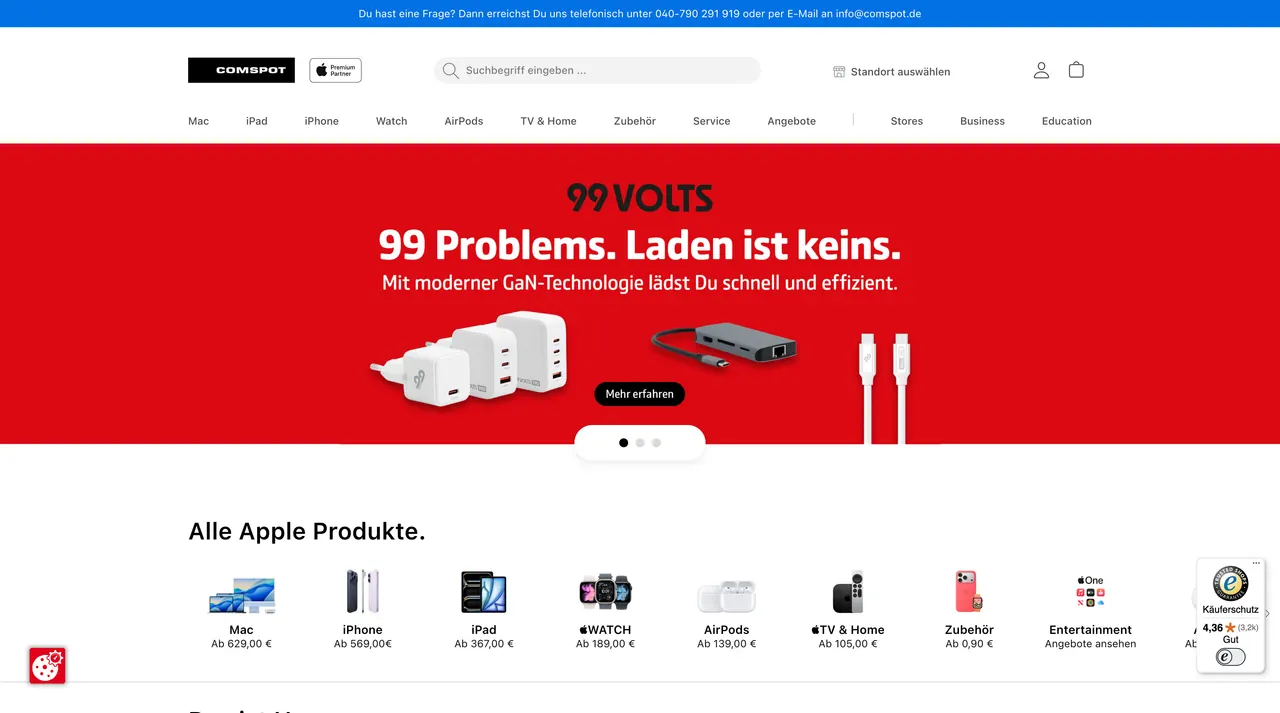
Since the 2021 relaunch, nuonic has run and evolved COMSPOT's online shop — from Shopware 5 to 6.7, with more than 1,500 work items across four years.
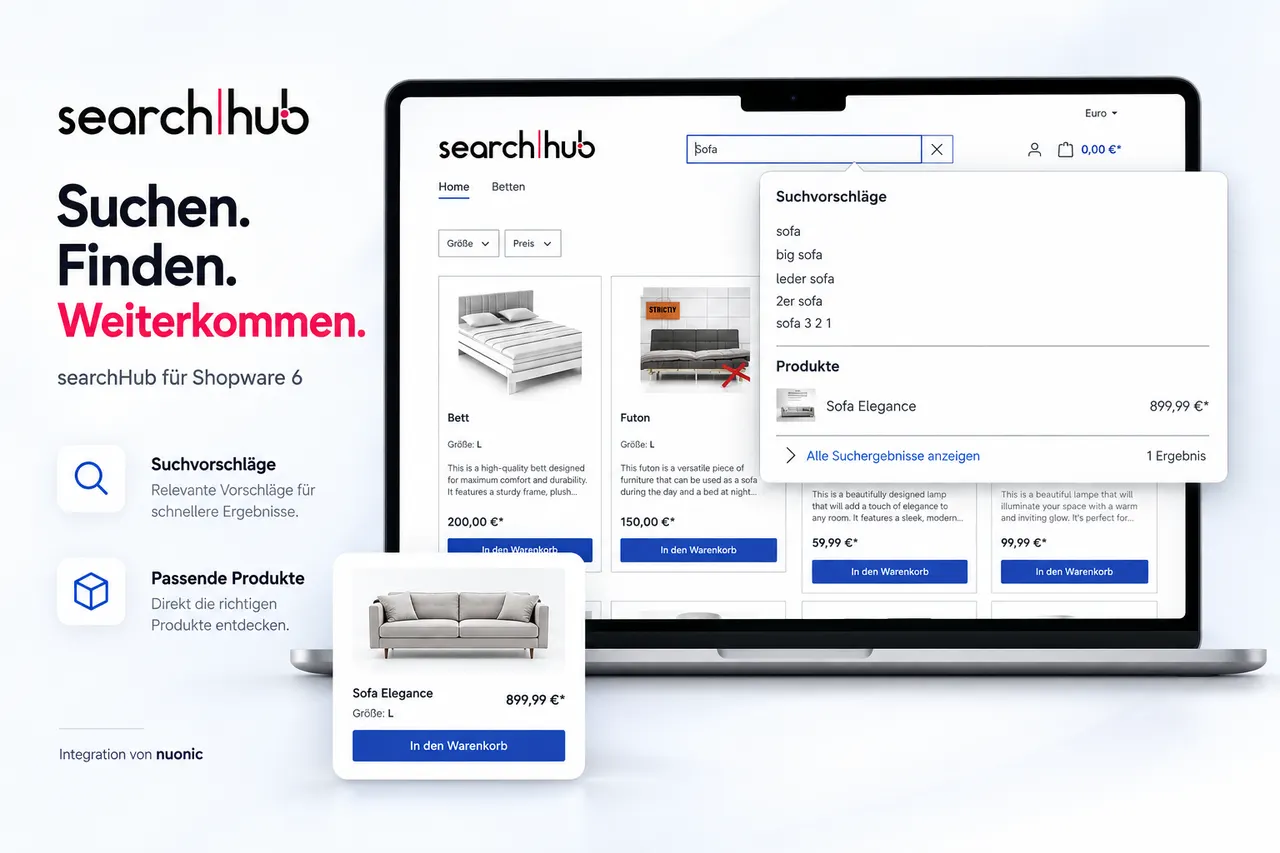
nuonic developed the searchHub integration for Shopware 6 with CXP Commerce Experts. Already implemented at COMSPOT. Explore the project and client testimonial.
 ~3 months
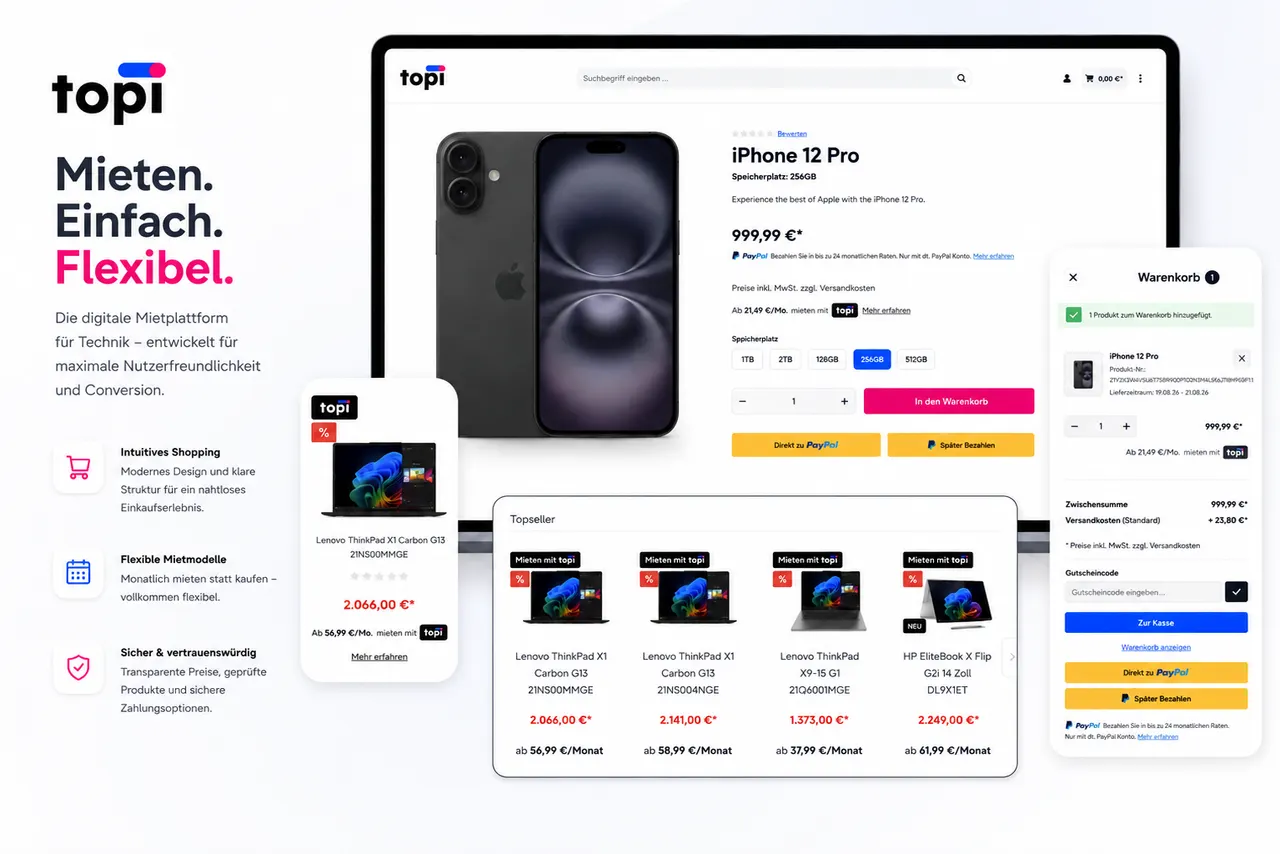
nuonic built the Shopware integration that brings topi's B2B rental payment straight into the checkout of well-known ITC retailers. One plugin for many shops.
How we build — without exception.
Against the public API
No core hacks, no blind overrides. Every extension uses the documented Shopware APIs and events — that's the difference between update-safe and update-blocking.
Test coverage over test courage
Automated tests run with every deploy and every Shopware update. Errors surface in the pipeline, not in your customers' checkout.
Storefront without dogma
Shopware storefront where it's enough — headless with a custom frontend where performance or multi-channel demand it. The architecture decision follows the requirement, not the trend.
Who builds it, owns it
The engineer who builds your extension also operates it — and talks to you directly. No ticket systems between problem and person.
Custom development is an investment decision.
- Small theme tweaks that don't justify our setup.
- Code without tests, docs and review.
- Feature requests without a look at the process behind them.
- Merchants whose processes no standard plugin can map.
- B2B requirements — pricing logic, approvals, customer portals.
- Shops with an ERP, PIM or CRM landscape that needs clean integration.
Development questions.
Custom development or an off-the-shelf plugin? +
If a well-maintained store plugin covers 90% of the requirement, we recommend the plugin — custom development pays off where processes are your competitive edge. We make that trade-off transparent in the analysis, including follow-up costs of both paths.
What does Shopware plugin development cost? +
Small extensions start at a few thousand euros; complex modules with integrations reach five figures. What drives cost is the processes behind them, not the line count — after the analysis you get a reliable number.
Does custom code stay update-safe? +
Yes — if it's developed against the public APIs and cleanly encapsulated. That's exactly how we build, secured by automated tests that run with every Shopware update.
Agency or freelance Shopware developer? +
For an isolated module a freelancer can be enough. For business-critical systems you need review, cover and operational responsibility — that's what a practiced senior team with an SLA provides. With us, the engineer is also your contact person.
Do you take over code built by other agencies? +
Yes, regularly. The entry point is a code audit assessing condition, risks and update capability. Then you decide on facts: what stays, what gets refactored, what needs rebuilding.
What's the difference between a Shopware plugin and an app? +
Plugins run inside the Shopware process itself — maximum depth, intended for self-hosted shops. Apps run decoupled via APIs and are the route for Shopware cloud environments. We build both and choose by hosting model and requirement, not by habit.
Does nuonic build headless frontends for Shopware? +
Yes. Via the Store API we decouple the frontend when performance, content commerce or multi-channel justify it — with modern frameworks like Nuxt. And we'll tell you just as clearly when the Shopware storefront is the more economical route.
Do you work with the Shopware B2B components? +
Yes — approval workflows, budgets, customer-specific pricing and order workflows are built on the B2B components where they carry, and extended individually where your processes demand more. We draw the line between standard and custom in the audit, not in a change order.