Case Study · F.O.C.U.S.

Xucker goes live. A system that generates revenue.

Replatforming Xucker from Shopware 5 to Shopware 6 — and two years of continuous development after that. Delivered with the nuonic F.O.C.U.S. framework. Because go-live is not a success. It is where responsibility begins.
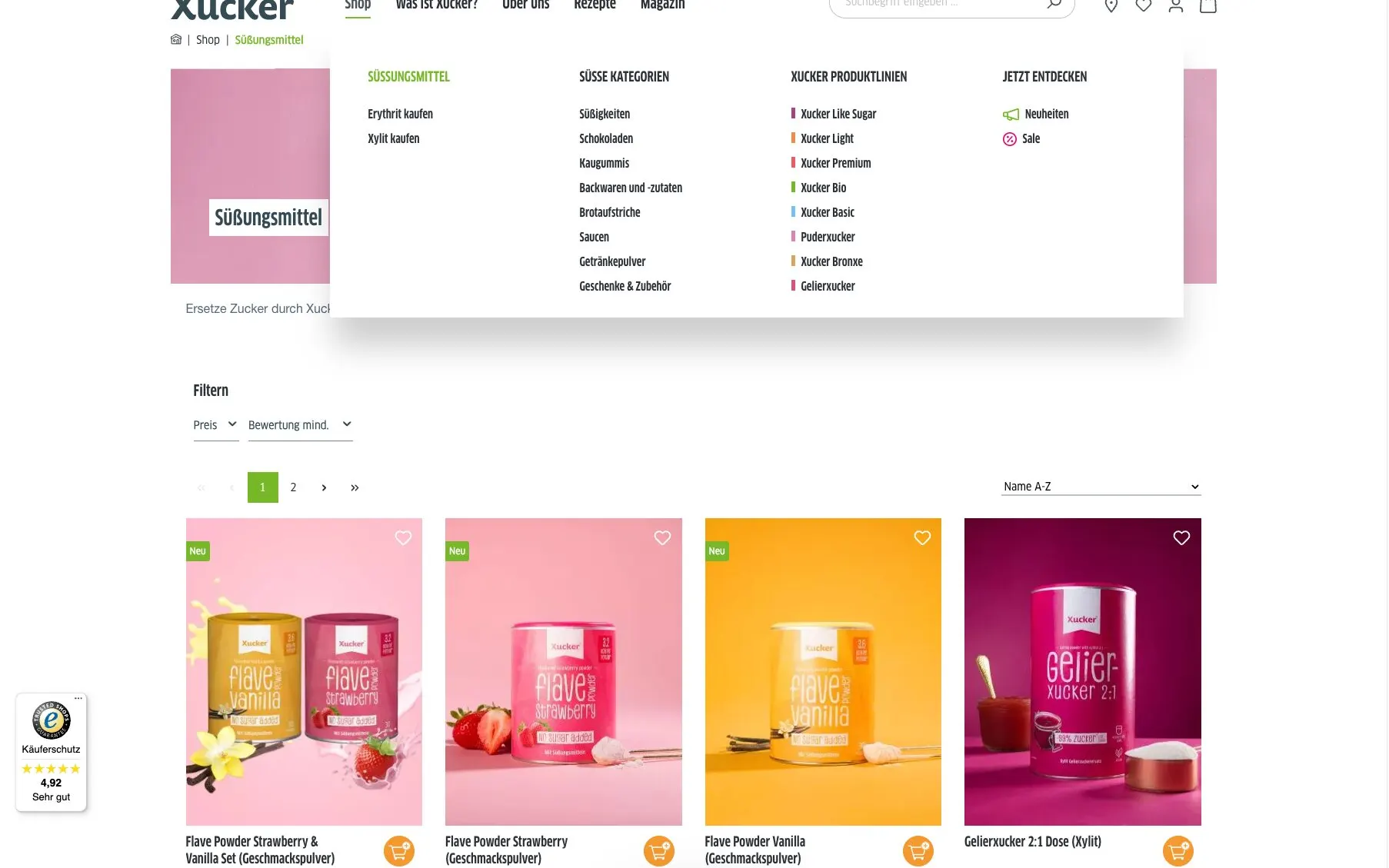
Xucker D2C shop on Shopware 6
FFacts

Reality over assumptions

OObjectives

Clarity before speed

CConstraints

The truth about systems

UExecution

Build, don't discuss

SScaling

Growth is a system

At a glance
Client
Xucker – sugar-free & sugar-reduced food
Industry
Food / D2C E-Commerce
Starting point
Shopware 5 (end of support)
Target platform
Shopware 6
ERP
SAP Business One (Sync4)
Delivery
2022 – Go-live Nov. 2023
Continuous development
Nov. 2023 – end of 2025
Services
Replatforming · Plugins · Deployment · Maintenance
Shopware 6SAP Business OneSync4Experience WorldsPlugin DevelopmentOpenSearchRedisKlaviyoMollieBFSGServer-Side TrackingDeployment Pipeline
F

Facts— Reality over assumptions

Xucker stands for sugar-free and sugar-reduced food — a content-driven D2C shop with recipes, a magazine, and products that need explaining. The basis: Shopware 5 with end of support on the horizon, custom-grown commerce logic, and SEO substance built up over years. The system audit showed: the platform wasn't limiting today's revenue, but every future decision.


O

Objectives— Clarity before speed

Not "a new shop", but clearly defined goals before the first line of code:

  • A future-proof platform before Shopware 5's end of support — via a Shopware migration without loss of functionality.
  • Preserve the content worlds: recipes, magazine, and storytelling as experience worlds — an upgrade, not a compromise.
  • Business logic as clean plugins instead of core modifications — update-capable from day one.
  • Go-live without a break: fully migrate customers, orders, reviews, and SEO substance.
C

Constraints— The truth about systems

The critical conditions were named before implementation, not discovered during it:

  • Live operation — the migration ran during full daily business.
  • Data from Shopware 5: existing customers, order history, thousands of reviews.
  • Fixed system landscape: SAP Business One as ERP (via Sync4), Trusted Shops, tracking setup.
  • Grown URL structure — every lost URL is lost revenue.

The decision formula behind every work item

Impact on revenue, commitment to the deadline, ownership of the result. Projects don't fail because of technology, but because of unclear facts, goals, and limits. The framework forces clarity — before the first line of code.

591
Total work items
9
Custom plugins
54
Releases in operation
3.5 yrs
Partnership

Execution & Scaling

Go-live is not a success. It is where responsibility begins.

U

Execution— Build, don't discuss

148 work items, structured into five epics: base setup, frontend & theme, backend & custom plugins, experience worlds, go-live & deployment. No endless concept phases — iterative delivery with a staging system and deployment pipeline from the very first work item.

  • 9 custom plugins instead of core hacks: minimum order quantities, direct debit payment, content teasers, product sliders, custom experience-world elements, and more — every requirement encapsulated and update-capable, following the standards of our Shopware development.
  • Content migration with substance: recipes, magazine, FAQs, and brand pages rebuilt as experience worlds — including rich snippets for recipes and reviews.
  • Data migration without a break: existing customers, order history, and imported reviews from Shopware 5.
  • ERP integration secured: SAP Business One via Sync4 — articles, stock, and orders in automatic sync, throughout the migration.

Go-live in November 2023 — during live operations, on schedule.

S

Scaling— Growth is a system

And this is where a project becomes a partnership. After go-live, nuonic took full responsibility for Shopware support & maintenance and continuous development — 443 further work items, prioritized by data:

  • 54 releases in two years — continuous instead of big bang.
  • Shopware 6.5 → 6.6 → 6.7 — major updates without downtime in daily business.
  • BFSG accessibility implemented before it became a risk — including legal requirements from the legal opinion.
  • Performance as a standing order: search moved to OpenSearch; sessions, cache & cart offloaded to Redis.
  • Marketing stack expanded: Klaviyo, server-side tracking, Mollie as payment provider, affiliate and marketplace integrations.

Go-live is not a success. It is where responsibility begins.

Two years later, the shop was running on a more current Shopware version than on day one — with more features, better performance, and legal requirements fulfilled.

Numbers from two years of operation
Work items
443 after go-live
Releases
54 deployments
Shopware versions
6.5 → 6.6 → 6.7
Compliance
BFSG & legal opinion implemented
Risk
0 big-bang risks
Model
Full operations & development ownership
Release ManagementShopware 6.7OpenSearchRedisKlaviyoMollieBFSGServer-Side Tracking
Four roles, one team

Four roles, from facts to scaling.

Responsibility across the full cycle — operationally tied to the phases, with no handoffs into the void.

Strategist

Clarify facts, goals, and limits – before anything is built.

Architect

Update-capable structure – plugins instead of core hacks.

Builder

Deliver iteratively – with pipeline, staging, and review.

Operator

Own operations, updates, and continuous development.

Contact

Is your shop managing instead of growing? Let's talk about impact.

nuonic Digital GmbH & Co. KG · Munich & Hamburg
Benedikt Rillox and Alex Jank, the founders of nuonic Digital