Case Study · F.O.C.U.S.

We don't build shops. We build systems that generate revenue.

Replatforming Handelskönig GmbH from JTL-Shop to Shopware 6 — delivered with the nuonic F.O.C.U.S. framework: from fact analysis to continuous scaling. Because go-live is not a success. It is where responsibility begins.
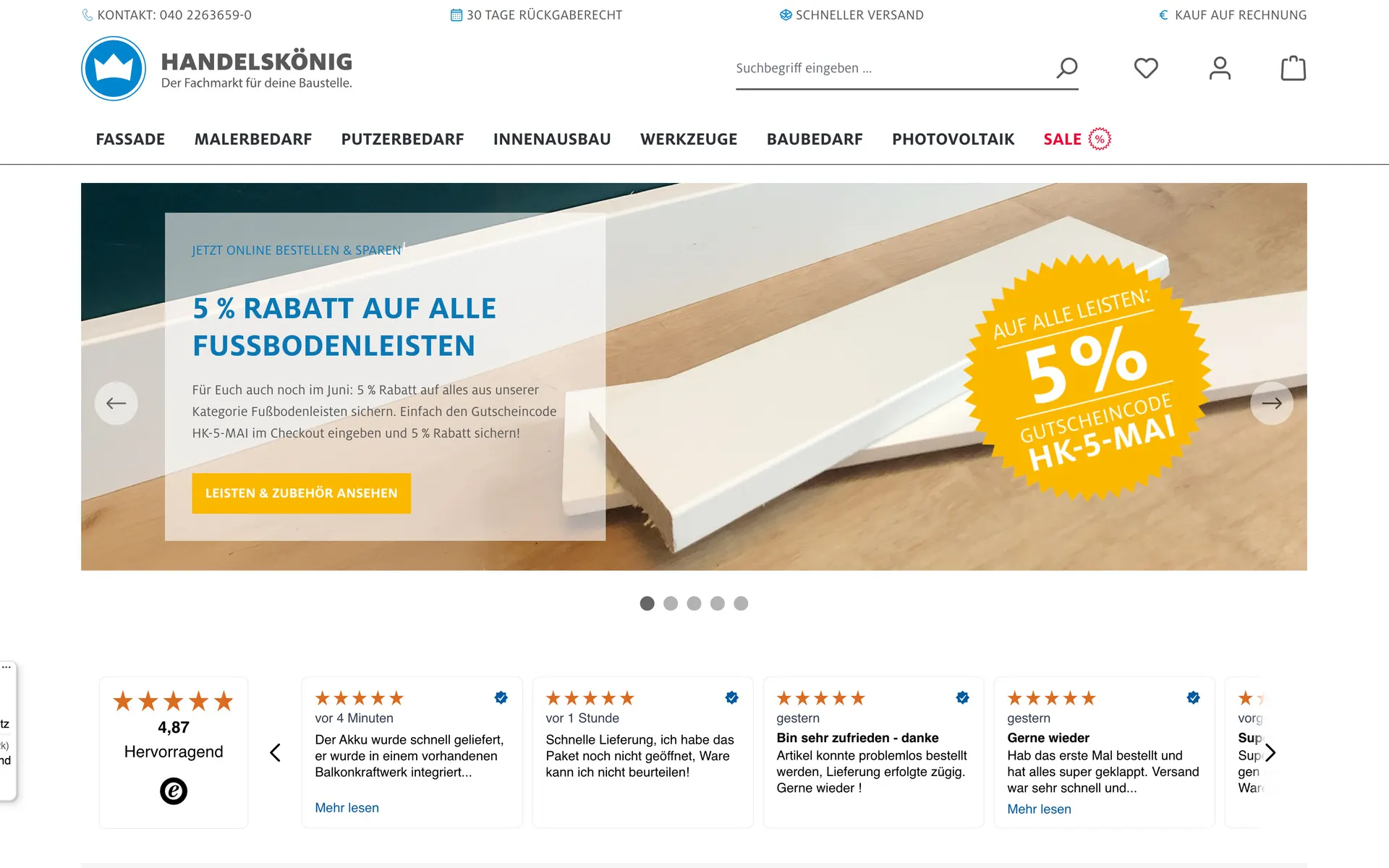
Handelskönig e-commerce on Shopware 6
FFacts

Reality over assumptions

OObjectives

Clarity before speed

CConstraints

The truth about systems

UExecution

Build, don't discuss

SScaling

Growth is a system

Project at a glance
Client
Handelskönig GmbH
Store
handelskoenig.com
Industry
Retail / Construction & Trade Supplies
Location
Hamburg, founded 2009
Platform
Shopware 6 (self-hosted)
ERP
JTL-Wawi (JTL-Connector)
Payment
PayPal, Amazon Pay, RatePay, invoice
Go-Live
October 2024
Status
Scaling phase (ongoing)
Shopware 6JTL-ConnectorCI/CD PipelineLoyalty SystemTrusted ShopsSEO MigrationKlaviyo

Brand Overview— Who Handelskönig is

Handelskönig GmbH has been a specialist building-materials retailer since 2009 and runs its online shop at handelskoenig.com alongside its location in Hamburg-Billbrook. The assortment covers the entire construction site: facades and external insulation systems, painting and plastering supplies, machine technology, drywall and interior finishing, tools, and photovoltaics.

The customer base is mixed — and that is precisely where the demand on the platform comes from: painters, plasterers, and drywall contractors buy commercially and in volume, while DIY customers use the classic B2C cart. The shop has to serve both buying patterns: from the single item all the way to a calculated project request for a complete construction site.

F

Facts— Reality over assumptions

The situation before Shopware: The existing JTL-Shop limited growth in three places at once. The frontend could only be adapted to the brand and to the buying patterns of trade customers to a limited degree. Content maintenance — experience pages, category copy, campaign areas — consumed development time instead of sitting with marketing. And every requirement that went beyond the standard ended in a workaround rather than a clean extension. Larger volume and project requests from trade customers ran entirely outside the shop: phone, email, spreadsheet.

The system audit made visible where time and conversion were being lost — and where the technical scaling limits lay. The consequence: the move to Shopware 6 as a planned Shopware migration instead of a risky big bang.

O

Objectives— Impact over features

Not "we need a new shop", but measurable goals: a platform that grows with the business, seamless JTL-Wawi integration without data breaks, preservation of the established SEO substance, and a deployment process that enables continuous releases instead of preventing them.

C

Constraints— Making limits visible

The critical conditions were named before implementation, not discovered during it: JTL-Wawi as the fixed ERP, ongoing business operations without interruption, full migration of customers, orders, and loyalty points with continuous number ranges, plus a URL structure grown over years that could not be allowed to break.

Why Shopware 6

The obvious alternative would have been to keep extending the JTL-Shop — but that is exactly where the limits were. Shopware 6 was chosen because four things came together: Shopping Experiences for content without a development ticket, an open plugin system with a Data Abstraction Layer on which custom business logic is built natively instead of as a silo, an established JTL-Wawi connector that leaves the fixed ERP untouched, and self-hosted operation with an own CI/CD pipeline and a documented upgrade path. The years since have confirmed the decision: the 6.6 → 6.7 major update ran without downtime, and the B2B quote process could be built as a native Shopware plugin.

Decision formula met

Measurable impact, the client's readiness to decide, clear ownership on both sides. Only then does a project start at nuonic.

~10 months
From facts to go-live
106 work items
In the execution phase
98 %
Completed at go-live
0 breaks
In data, SEO & operations

Execution & Scaling

Go-live was the starting point — not the goal.

U

Execution— Build, don't discuss

No concept loops, but a production-ready system from our Shopware development:

  • Custom theme: Built on the Shopware theme system — header, navigation (desktop & off-canvas mobile), product listing, product detail page, cart, and the Shopware checkout to the client's CI.
  • Content without a development ticket: Shopping Experiences with custom CMS elements. The team has maintained landing pages and campaign areas itself ever since.
  • JTL-Wawi integration: Sync of products, customers, orders, and stock levels via the JTL-Connector — Shopware as the commerce core, JTL-Wawi as the leading ERP.
  • Data migration: Customers, orders, loyalty points, and reviews fully migrated — continued through Shopware number ranges without a gap.
  • Plugin stack: Loyalty system, PayPal, Amazon Pay, Trusted Shops, comparison list, and blog — extended by custom plugins built on Shopware standards.
  • Automate everything: Stage/production environments with an automated deployment pipeline, monitoring, alerting & logging from day one.

Go-live in October 2024 — on schedule, during live operations. For the budget range a replatforming of this scale moves in, see our pricing page.

Shopware in use
Version
6.6 → 6.7.x
Operation
Self-hosted (stage & production)
Content
Shopping Experiences + custom CMS elements
Custom development
Plugins on DAL & state machine
Interface
JTL-Connector
Deployment
CI/CD pipeline
Shopping ExperiencesTheme systemPlugin system & DALShopware checkoutNumber rangesState machineFlow BuilderDocument rendererRoles & permissionsPayment integrations
S

Scaling— Growth is a system, not luck

Since go-live, the continuous optimization cycle has been running — Shopware support & maintenance with a fixed release rhythm instead of ad-hoc firefighting:

  • B2B quote process (since August 2026): Volume and multi-item requests run directly in the shop. Sales calculates with Shopware's pricing logic, the quote PDF is rendered in the Shopware document layout, and acceptance turns into a regular Shopware order — built as a native plugin on the DAL, state machine, and Flow Builder events instead of as a silo.
  • 40+ releases through the automated pipeline — planned, tested, documented.
  • Shopware 6.6 → 6.7 as a major update without downtime, including theme and plugin adjustments.
  • Proactive compliance: GPSR, BFSG preparation, and EEA-compliant conversion tracking — implemented before they became a risk.
  • Growth stack: Klaviyo (flows, back-in-stock, product feed), Trusted Shops widgets, server-side tracking.
  • Performance & conversion: Image formats, CDN, availability and delivery-time logic, checkout optimization — prioritized by data.

Impact over activity

Nearly 290 work items since go-live are not busywork — they are proof that an actively operated shop is a living system. Responsibility doesn't end at go-live. It begins there.

Scaling in numbers
Timeframe
Since Oct. 2024 (ongoing)
Total work items
≈ 290
Releases
40+ deployments
Shopware versions
6.6 → 6.7.x
Compliance
GPSR, BFSG, EEA tracking
Model
Maintenance with a fixed release cycle
Release ManagementShopware 6.7GPSRBFSGKlaviyoServer-Side TrackingPerformance

KPI Results

What measurably changed.

Results— Before / after

The replatforming is not measured by the launch, but by what has run differently since:

  • Release capability: previously manual and ad hoc — today 40+ tested deployments in 24 months through the CI/CD pipeline. On average one release every two and a half weeks, planned and documented.
  • Platform upgrades: previously a risk event you postpone — today predictable operations: Shopware 6.6 → 6.7 without downtime, including theme and plugin adjustments.
  • Content maintenance: previously one development ticket per landing page — today the Handelskönig team maintains Shopping Experiences and campaign areas itself. Development time goes into features instead of content.
  • B2B volume demand: previously phone, email, and spreadsheets entirely outside the shop — today a continuous process from the request through the calculated quote PDF to a regular Shopware order.
  • Data continuity: 0 breaks in data, SEO, and operations. Customers, orders, loyalty points, and reviews fully migrated, number ranges continued without a gap, and the URL structure grown over years preserved.
  • Go-live: 98% of the planned scope on schedule — without interrupting day-to-day business.
  • Operating model: a fixed release cycle continuously since October 2024 instead of ad-hoc firefighting — around 290 work items have gone through the pipeline in a controlled way since then.

Current state & outlook— Where the system stands today

Today: The shop runs on Shopware 6.7, self-hosted, with separate stage and production environments and a fixed release cycle through the automated pipeline. The B2B quote process has been live since August 2026, GPSR is implemented, BFSG preparation is under way, and conversion tracking is EEA-compliant.

Next: The quote process is not measured by the number of requests, but by response time, acceptance rate, and the revenue generated from it — those metrics drive the next expansion steps. Added to that are the Digital Product Passport as a mandatory topic, further automation between Shopware and JTL-Wawi, and data-driven conversion work in the checkout. The model stays the same: identify a recurring manual process, turn it into a product feature, roll it out in a controlled way, measure it.

What the platform delivers — and what the partner delivers

Shopware 6 provides the commerce core: cart and tax logic, Shopping Experiences, documents, roles and permissions, an open data layer, and a documented upgrade path. nuonic provides the responsibility on top: architecture, migration without data breaks, deployment automation, release rhythm, compliance ahead of the deadline, and custom plugins that reuse Shopware standards instead of duplicating them. Together, that is not a project that gets completed, but a system that gets operated.

The roles in the project

Four roles, from facts to scaling.

Responsibility across the full cycle — operationally tied to the phases, with no handoffs into the void.

Strategist

  • Goals & prioritization

Architect

  • System design & integrations

Builder

  • Delivery & quality

Operator

  • Operations & growth
I had imagined the complete migration of our shop to Shopware 6 to be far more nerve-wracking. nuonic ran the project so methodically — from the development environment through data migration and the JTL connection all the way to go-live — that we could focus on day-to-day business instead of putting out fires. The new theme, the checkout, and the entire plugin landscape – AmazonPay, PayPal, Trusted Shops, our loyalty system – ran smoothly from day one. But what truly won us over is the time afterwards: releases arrive in a reliable rhythm, bugs are fixed quickly and traceably, and with Shopware updates or security patches nuonic reaches out proactively before things become critical. Even on mandatory topics like the Digital Product Passport, the team thinks ahead instead of just ticking boxes. For us, this is no longer a mere agency relationship, but a true technical partner.
Katja Thal - Handelskönig GmbH · on working with nuonic
Contact

Want systems instead of projects? Let's talk about impact.

nuonic Digital GmbH & Co. KG · Munich & Hamburg