Shopware 6.7: What the major release adds and why upgrading is worthwhile
Shopware 6.7 modernizes performance, accessibility, and technology. We explain the key additions across the 6.7 line and a safe upgrade process.

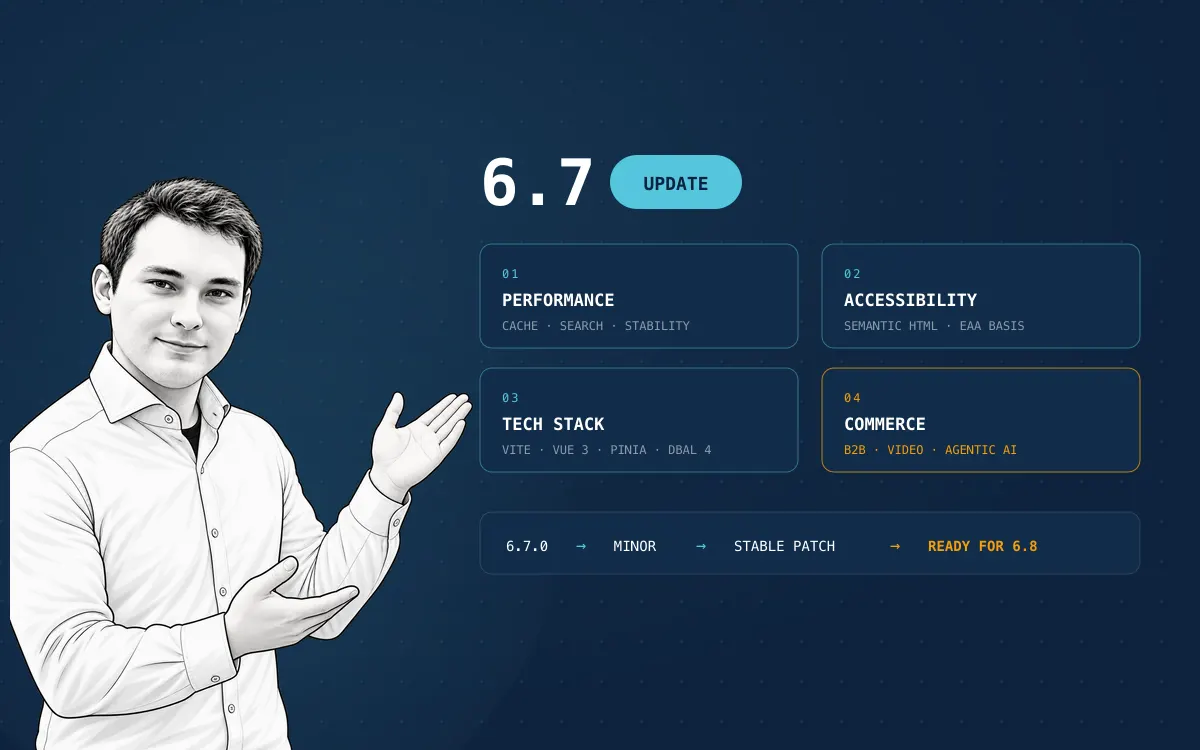
Shopware 6.7 is the current major release: published on June 17, 2025 and extended monthly since, up to the verified state 6.7.12.2 of July 23, 2026. It modernizes accessibility, caching, and the Administration (Vite, Vue 3, Pinia) and delivered native language management, B2B Individual Pricing, Product Bundles, the Withdrawal Button, and Agentic Commerce in its minor releases.
This division often causes confusion. Shopware 6.7.0.0 primarily changed accessibility, caching, the Administration, and the developer stack; the commerce features followed later within the same 6.7 line. This article therefore considers the whole development: the benefits merchants receive today, what extensions and themes may need to change, and how to upgrade without unnecessary operational risk.
What does a Shopware major release mean?
A Shopware major release bundles technical changes where complete backward compatibility is not always possible; new commerce capabilities often arrive in the minor versions that follow. In practice: 6.7.0.0 establishes the modernized platform foundation, the 6.7.x releases add features, improvements, and fixes on top of it — and plugins, apps, themes, and customizations must explicitly support the new foundation. A major upgrade therefore requires more testing than a routine patch update.
Shopware 6.7.0.0 was officially released on June 17, 2025. According to the release notes overview, Shopware 6.6 moved into extended support, receiving security fixes but none of the active product line's new functionality.
The most important changes in Shopware 6.7.0
Five changes define the 6.7.0 release: accessibility enabled by default with the European Accessibility Act in mind, the Administration's move from Webpack to Vite, the full switch to Vue 3 with Pinia, a fundamentally reworked cache, and updated core libraries such as DBAL 4 and PHPUnit 11. The complete technical list is in the official release information.
1. Accessibility improvements are enabled by default
Shopware revised storefront templates, font sizes, semantic HTML, focus
behavior, and other controls with the
European Accessibility Act
in mind. Some
of these changes were already available in 6.6 behind the
ACCESSIBILITY_TWEAKS feature flag. They are enabled by default in 6.7.
This is an important foundation, not an automatic guarantee of an accessible store. Custom themes, CMS content, color contrast, alternative text, forms, and extensions still need to be reviewed.
The upgrade provides a better core baseline. Agencies spend less effort working around old markup structures and can test the individual storefront against a more modern standard.
2. The Administration moves from Webpack to Vite
Shopware 6.7 modernizes the Administration build process by replacing Webpack with Vite. This improves modern frontend workflows but is a real compatibility boundary for Administration extensions.
Plugins with custom Admin modules generally need adjusted builds or separate versions for 6.6 and 6.7. An upgrade review must check whether the exact installed plugin version explicitly supports 6.7.
3. Vue 3 and Pinia modernize the Administration
Shopware 6.7 leaves Vue 3 compatibility mode and uses Vue 3 natively. Pinia replaces Vuex for state management.
Merchants do not immediately see this change, but it improves maintainability, extensibility, and compatibility with the current Vue ecosystem. Developers need to inspect custom Admin components, mixins, stores, and component overrides.
4. Caching is fundamentally reworked
Shopware combines and delays cache invalidations to avoid unnecessarily discarding entries. The separate Store API caching layer was removed. The goal is a higher cache hit rate, lower storage use, and more stable performance when data changes frequently.
A cache rework is not a universal performance switch. Reverse proxy, Redis, queue workers, product indexing, custom subscribers, and hosting need to be considered together. Load tests and real cache-hit measurements belong in the post-upgrade review.
5. Core libraries are updated
Important updates include DBAL 4, PHPUnit 11, League OAuth2 Server, and DomPDF. They prepare Shopware for current PHP, database, and framework versions.
Custom code using internal library APIs may need changes. Bespoke database queries, tests, document generation, and authentication logic deserve a focused review against the official upgrade guide.
What was added later across the Shopware 6.7 line?
Since 6.7.0, Shopware has extended the platform through regular minor releases – from the faster OpenSearch search in 6.7.2, through native language management, B2B expansion, video, and the Withdrawal Button, to Agentic Commerce and AI Discovery Files in 6.7.10 through 6.7.12. This table summarizes the most relevant steps for merchants and project owners; each version links to its official release notes on GitHub.
| Version | Focus and examples |
|---|---|
| 6.7.2 | Faster OpenSearch product search plus performance, SEO, and accessibility improvements |
| 6.7.3 | Native installation and maintenance of Shopware languages without a separate language pack |
| 6.7.4 | Extended Subscriptions, new B2B Components, and Copilot Data Insights |
| 6.7.6 | Security, caching, and Administration improvements |
| 6.7.7 | More detailed GA4 ecommerce events, 3D improvements, and revised cookie consent |
| 6.7.8 | Video as a native media type, B2B Individual Pricing, and integrated GMV Reporting |
| 6.7.9 | Withdrawal Button, Product Bundles, and Copilot chat history |
| 6.7.10 | Experimental Agentic Commerce sales channel and extended Analytics foundations |
| 6.7.11 | Better mail preview, search redirects, and a new storefront component system |
| 6.7.12.1/2 | AI Discovery Files, search options, a Rule Builder extension, and fixes |
Not every capability is included in Community Edition. B2B, AI, Analytics, and other commercial features may require a particular Shopware plan or separate service.
Better performance for large catalogs
Version 6.7.2 significantly improved product search with OpenSearch. In its release announcements, Shopware reports improvements between 33 and 200 percent depending on the environment. Later releases added searches by EAN and manufacturer number and direct product page redirects when exactly one item matches.
This is especially relevant to B2B stores and spare-parts catalogs where buyers search with known identifiers. The actual result still depends on the index, analyzers, data quality, and infrastructure.
Language management moves into Shopware core
Starting with 6.7.3, available Shopware translations can be installed and updated natively. The former language-pack extension is no longer required for these languages and will not be supported from Shopware 6.8 onward.
International stores remove one plugin dependency. Custom snippets, localized content, SEO metadata, and editorial translation workflows still need clear ownership.
B2B, quoting, and individual prices
The 6.7 line progressively expanded B2B Components: organizational units, budgets, approvals, quoting, customer-specific assortments, and rule-based Individual Pricing from 6.7.8. The upgrade is also strategically relevant to B2B merchants because Shopware plans to end support for the older B2B Suite with 6.8 – new B2B capabilities are being built exclusively in B2B Components.
The plan, data migration, and functional coverage need to be assessed before changing systems.
Media, products, and commerce functionality
Video has been a native media type since 6.7.8, making it easier to use consistently in products and CMS content. Product Bundles allow related items to be sold as a package. Subscriptions, 3D functionality, and quotation processes have also continued to evolve across 6.7.
The commercial benefit does not come from activation alone. A function creates value when it reliably replaces plugins, manual work, or custom development.
Compliance and better measurement
In addition to its accessibility foundations, the 6.7 line delivers four practical compliance and measurement tools: the Withdrawal Button for the digital withdrawal process that has been mandatory in Germany since June 2026, extended GA4 ecommerce events, integrated GMV Reporting, and a revised cookie consent flow. These are tools, not automatic legal compliance – configuration, consent, and analytics data quality still require store-specific validation.
- The Withdrawal Button supports the legally required digital withdrawal workflow relevant to affected German B2C stores since June 2026.
- Extended GA4 events add basket, checkout, brand, and category information.
- Integrated GMV Reporting automates aggregated reporting for relevant Shopware Accounts.
- Cookie consent and Administration transparency have been improved.
Agentic Commerce and AI Discovery
From 6.7.10, Shopware progressively opened the platform to AI channels: an
experimental Agentic Commerce sales channel publishes product data through
platform-specific feeds – initially for OpenAI – and attributes AI-generated
traffic using existing affiliate mechanisms. Version 6.7.11 added an
experimental MCP server, and 6.7.12 added optional AI Discovery Files such as
llms.txt and agents.md. Our article on
AI sales channels with Shopware
shows how to turn this into a measurable pilot channel.
The word experimental matters. These capabilities are suitable for controlled evaluation, not automatically as a fixed foundation for business-critical processes. Permissions, data scope, monitoring, and fallbacks need definition.
A new foundation for storefront development
Shopware 6.7.11 introduced Twig UX Components, a Vite-based storefront dev server, CSS custom properties generated from theme settings, and a global JavaScript event system. Existing themes are not automatically rewritten – but new components and incremental modernization gain a clearer, reusable development path.
Why upgrading to Shopware 6.7 is worthwhile
Five reasons make the case: active development now happens only in the 6.7 line, better technical future-readiness through Vue 3, Vite, and the new cache, measurable performance and stability gains, less legacy work before Shopware 6.8 planned for 2027, and access to current functionality from B2B Individual Pricing to Agentic Commerce.
Active development
New core and commercial functionality appears in the active 6.7 line, while 6.6 in extended support primarily receives security corrections.
Technical future-readiness
Vue 3, Pinia, Vite, current libraries, and new caching create a foundation for future extensions and Shopware versions.
Performance and stability
Caching, search, Administration, and failure handling have improved across many releases. Large catalogs and integration-heavy setups can benefit measurably.
Less legacy work before Shopware 6.8
Resolving deprecations, plugin compatibility, and infrastructure requirements under 6.7 reduces the eventual step to 6.8, which Shopware plans for 2027 — what is already known about 6.8 is summarised separately.
Access to current functionality
B2B Individual Pricing, native video, language management, Product Bundles, Agentic Commerce, and AI Discovery are compelling when they match the business model.
What to consider before upgrading
Never trial a major upgrade directly in production. The checklist runs from plugin and theme compatibility, through Admin extensions (Vite, Vue 3, Pinia), infrastructure versions, and API integrations, to backups, rollback, and a maintenance window. Especially important: 6.7.12.0 contained a critical issue – install at least 6.7.12.1. The critical checks in detail:
- compatibility of every plugin, app, and theme,
- custom Admin extensions affected by Vite, Vue 3, and Pinia,
- storefront overrides and accessibility markup,
- PHP, database, Redis, OpenSearch, and Node versions,
- queue workers, cron jobs, reverse proxy, and cache configuration,
- ERP, PIM, CRM, payment, and shipping integrations,
- changes from the official upgrade guide and deprecations,
- backups, rollback, and a maintenance window.
Important: Shopware 6.7.12.0 contained a critical issue and, according to the July 2026 release news, must not be installed. Use at least 6.7.12.1 or a newer approved patch release.
Recommended upgrade process
Nine steps take the upgrade live without unnecessary operational risk: from a system inventory, through compatibility confirmations, a production-like stage, and the technical upgrade, to automated tests, business tests, a performance comparison, launch and rollback planning, and close monitoring. The official upgrade guide adds the technical details per version.
- Inventory the system: Document versions, extensions, custom code, infrastructure, and integrations.
- Confirm compatibility: Obtain vendor releases and replace abandoned extensions.
- Create a production-like stage: Reproduce data volume, configuration, workers, search, and caching.
- Perform the technical upgrade: Check Composer conflicts, migrations, Admin builds, and logs.
- Run automated tests: Cover APIs, checkout, rules, payments, and core business processes.
- Run business tests: Involve sales, service, content, and logistics with realistic scenarios.
- Compare performance: Measure response times, queues, search, cache hits, and database load before and after.
- Plan launch and rollback: Define owners, monitoring, maintenance window, and abort criteria.
- Monitor closely: Watch logs, orders, payments, feeds, and integrations during the first days.
Conclusion: 6.7 is now a mature product line
At launch, Shopware 6.7 was primarily a technical foundation. More than a year later, it has become a substantial product line with improvements to search, B2B, media, compliance, Analytics, Administration, and AI commerce.
The upgrade is particularly worthwhile for merchants who want current functionality, a modern platform, and preparation for 6.8. Its success still depends on a complete compatibility review and production-like testing.
Official sources
Let's talk about your system.
No pitch deck. A conversation with the people who build.