Shopware 6 plans in 2026: Pricing and differences compared
Community Edition, Rise, Evolve or Beyond? We compare current prices, features, support and total costs across the Shopware 6 plans.

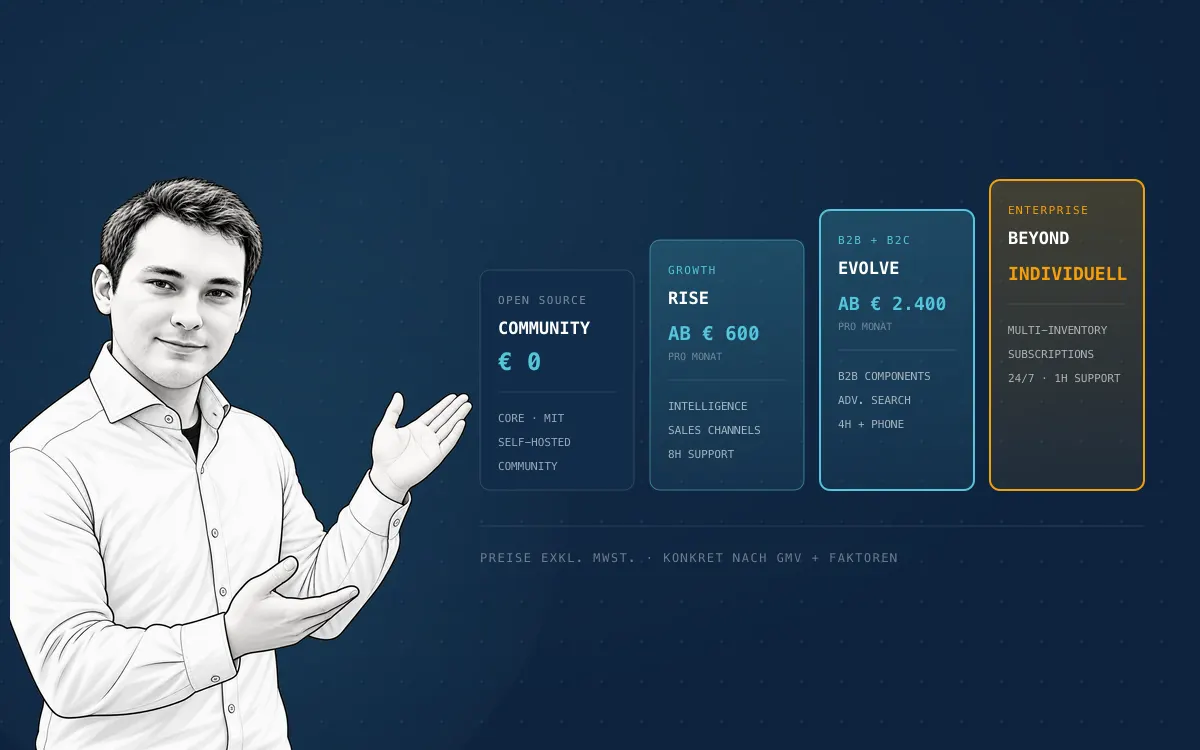
Shopware 6 is available for free and, at the same time, for several thousand euros per month. Both statements are correct: Community Edition is the freely available open-source core with no licence fee, Rise starts at €600 per month, Evolve at €2,400 per month, and Beyond is quoted individually. The commercial plans add features and direct support from Shopware on top of the core.
The useful question is therefore not simply “What does Shopware cost?” It is: Which capabilities, response times and operating model does the business need, and which parts of total cost are actually covered by the Shopware fee?
This comparison reflects the official position on 17 August 2026. Prices and plan contents can change, so a current Shopware quote should always govern an actual budget decision.
Shopware 6 plans and pricing at a glance
The short version: Community Edition has no licence fee, Rise starts at €600 per month, Evolve at €2,400 per month, and Beyond is quoted individually – each excluding VAT and, according to the Shopware pricing page, dependent on Gross Merchandise Value (GMV) and other individual factors. Feature scope and support tier grow with the plan.
| Plan | Shopware list price | Focus | Support |
|---|---|---|---|
| Community Edition | €0 | Open-source core with full technical responsibility | Community |
| Rise | from €600 per month | Growth, additional commerce features and base support | 8-hour response |
| Evolve | from €2,400 per month | Complex B2C and B2B commerce | 4-hour response and phone support |
| Beyond | individual | Enterprise capabilities and mission-critical operations | 24/7 and 1-hour response |
Commercial plan prices exclude VAT. That places the published minimum at €7,200 per year for Rise and €28,800 per year for Evolve. Beyond is quoted individually. Shopware explicitly states that the actual price depends on Gross Merchandise Value, or GMV, and other individual factors. Starting prices are therefore not binding quotes for every merchant. Current amounts are published on the official Shopware pricing page.
Licence or plan? Separating the terms
People commonly talk about Shopware licences, but two technical and contractual layers need to be distinguished: Community Edition is the free Shopware core under the MIT licence; Rise, Evolve and Beyond are commercial subscriptions that build on that core and unlock additional features and support. A paid plan is therefore not a different commerce platform — it is the same core with more services.
Community Edition is the free Shopware core under the MIT licence. Its source code can be downloaded, self-hosted and modified. Shopware confirms on its Community Edition download page that the edition is free and open source.
Rise, Evolve and Beyond are commercial subscriptions. They build on the core and unlock additional features and support. A self-hosted installation uses the Shopware Commercial extension for this purpose; in Shopware Cloud it is already part of the environment.
A paid plan is not a fundamentally different commerce platform. The data model, Administration and technical core remain Shopware 6. The plan defines which commercial capabilities and level of vendor support are added.
Community Edition: No licence fee, but not free to operate
Community Edition already contains the foundation for a professional store: product and variant management, Shopping Experiences, Rule Builder, Flow Builder, languages and currencies, APIs and the customisable storefront framework. It is not a time-limited trial.
Its main advantage is freedom. Architecture, hosting, deployment, extensions and development workflow can all be selected independently. This can be commercially and technically attractive for organisations with an experienced internal team or long-term Shopware partner.
The other side of that freedom is responsibility:
- no technical support from Shopware,
- self-managed hosting and monitoring,
- internal update, backup and security processes,
- assessment and maintenance of every extension,
- troubleshooting by the internal team or implementation partner.
“€0 licence cost” does not mean “€0 platform cost”. Even a small production store needs hosting, maintenance, updates and someone accountable for incidents.
There is also a threshold concerning Shopware Account and Extension Store. Shopware states that businesses exceeding €1 million in annual GMV must move to a commercial plan if they want to continue using the Shopware Account and Store. Below that threshold, Community Edition stores can use them without a commercial plan. Shopware describes the details in its update on automated GMV reporting.
Who is Community Edition for?
It is a strong foundation where the required capabilities are available in the core, custom development or Store extensions, reliable technical coverage exists, and direct vendor support is not mandatory. A mission-critical store still needs contractual support from its implementation partner.
Rise: Entry into the commercial plans
Rise currently starts at €600 per month. It targets growing businesses that want commercial capabilities and a defined support route on top of the core, and includes written support with an eight-hour service response time within the published business hours.
Shopware highlights include:
- Shopware Intelligence and Agentic Commerce capabilities,
- unlimited sales channels,
- 3D and immersive commerce features,
- returns management,
- Custom Products and Social Commerce,
- extended preview and sharing functions for Rule Builder and Flow Builder.
The feature scope evolves with Shopware releases. The official documentation maintains the current list of Rise features.
Support has an eight-hour service response time within the published business hours. Written support is included; phone callback, hotline and developer support are not part of this tier.
When does Rise make sense?
Rise is useful when several included features replace real development or extension cost and the business needs a direct escalation path to Shopware. One feature alone does not automatically justify the plan. The combined value of features, vendor support and avoided custom maintenance matters.
Evolve: B2B, search and complex access rules
Evolve starts at €2,400 per month, includes all Rise capabilities, and adds the three most important building blocks for complex commerce: B2B Components, Advanced Search and Dynamic Access – plus phone support with a four-hour service response time. The large price step is aimed at companies whose requirements go beyond classic B2C commerce.
Key differences include:
- B2B Components: employees, roles, approvals, quick orders, shopping lists, organisation units and quote management,
- Advanced Search: more powerful product search based on OpenSearch,
- Dynamic Access: rule-based visibility for categories and products,
- further CMS, workflow and marketing functions,
- four-hour service response and phone support.
Shopware documents that B2B Components are available from Evolve. The same applies to Advanced Search and Dynamic Access.
When does Evolve make sense?
The plan is particularly relevant when B2B should not be assembled from a collection of disconnected custom solutions. For large catalogues, demanding search or customer-specific catalogues, Evolve can also be more maintainable than custom development.
The subscription does not implement the project by itself. B2B roles need ERP and customer-master integration, OpenSearch needs operating, and quote or approval processes require business configuration. Those implementation costs sit on top of the plan fee.
Beyond: Enterprise capabilities and 24/7 support
Shopware does not publish a standard starting price for Beyond. It is quoted individually, contains Rise and Evolve, and adds capabilities for complex or particularly business-critical setups – from Multi-Inventory, customer-specific pricing and subscriptions to 24/7 priority support with a one-hour service response and developer support.
The main additions are:
- Digital Sales Rooms for consultative sales journeys,
- Multi-Inventory for several warehouses and stock rules,
- customer-specific pricing,
- subscriptions and recurring orders,
- delayed Flow Builder actions,
- 24/7 priority support with a one-hour service response,
- developer support, personal onboarding and account management.
Shopware maintains the current list in its Beyond documentation.
When does Beyond make sense?
Beyond is as much an operating and risk decision as a feature decision. Multiple warehouses, individual prices or subscriptions can make it functionally necessary. The support tier matters where an outage outside business hours immediately puts substantial revenue, international markets or contractual service levels at risk.
Support compared directly
Support separates the plans more clearly than many features: from community support with no commitments, through written support with an eight-hour response (Rise) and phone support with a four-hour response (Evolve), to 24/7 support with a one-hour response, onboarding and account management (Beyond). Shopware maintains the full matrix in its feature documentation.
| Service | Community Edition | Rise | Evolve | Beyond |
|---|---|---|---|---|
| Vendor support | no | written | written and phone | extended, including developer support |
| Availability | Community | 09:00–17:00 | 07:00–19:00 | 24/7 |
| Service response | none | 8 hours | 4 hours | 1 hour |
| Personal onboarding | no | no | no | yes |
| Account manager | no | no | no | yes |
Shopware covers the stated business hours across Berlin and New York time zones. A response time is not the same as a guaranteed resolution time; it describes when support responds to a qualified case. Even with a commercial plan, the operating model therefore needs its own incident and escalation process. The full matrix is available in the Shopware feature documentation.
Self-hosted, SaaS and PaaS are not additional editions
Plan and deployment model answer different questions — but are frequently mixed up: the plan determines commercial features and support, while the deployment model determines who owns infrastructure, platform and updates. Every commercial plan can be combined with every deployment model; only Community Edition is limited to self-managed hosting. In detail:
Self-hosted offers maximum infrastructure control and custom development. Hosting, deployment, scaling and operations belong to the merchant or its service provider.
Shopware SaaS is operated by Shopware. Updates and infrastructure are part of the cloud model. Shopware states that SaaS is available at the same plan price as self-hosted.
Shopware PaaS combines Shopware-managed operations with more technical customisation and developer tooling. Pricing is individual.
For commercial plans, the deployment model still needs to fit the integration landscape, deployment process and compliance requirements.
The real Shopware cost: Seven budget blocks
The plan fee is only one of seven lines in the business case: hosting and infrastructure, implementation or migration, extensions, operations, transaction cost and internal cost come on top. A Community Edition store with many custom plugins can cost more to operate than Rise — the objective is not the lowest list price, but the least expensive sustainable architecture across several years. The blocks in detail:
- Shopware plan: €0, at least €7,200 or at least €28,800 per year, or an individual Beyond quote.
- Hosting and infrastructure: servers, database, search, CDN, backups, staging and monitoring unless included in the cloud model.
- Implementation or migration: discovery, design, data migration, integrations, development and testing.
- Extensions: Store apps, plugins, themes and third-party SaaS with their own monthly, annual or revenue-based fees.
- Operations: updates, security patches, quality assurance, incident resolution and release management.
- Transaction cost: payment, fraud prevention, marketplaces, shipping and any usage-based Shopware services.
- Internal cost: product data, content, campaigns, service and time from business teams.
Conversely, Rise can be unnecessary where its features create no measurable value.
Which plan fits? Seven decision questions
The short answer: Community Edition for technically self-sufficient teams that do not require vendor support, Rise for growing B2C stores that need commercial features, Evolve as soon as B2B Components, Advanced Search or Dynamic Access are required, and Beyond for mission-critical 24/7 operations. Whether that holds for a specific store is settled by these seven questions before requesting a quote:
- Which commercial capabilities will actually be in production within the next 24 months?
- Does the business need B2B Components, Multi-Inventory, subscriptions or customer-specific pricing?
- How much revenue and margin depend on every hour of store availability?
- Is an agency SLA enough, or is direct Shopware support required?
- Who owns hosting, updates and security?
- What are current GMV and forecast growth?
- Which custom developments and plugins could plan features replace, and which remain necessary?
These answers create a feature and operating matrix. Price comparison should only begin after that.
Switching and booking plans
According to Shopware, Rise can be booked directly through the Shopware Account or Administration. Evolve and Beyond require a conversation with Shopware. On self-hosted installations, the Shopware Commercial extension unlocks the plan capabilities.
Upgrading is technically simpler than downgrading later. Once business processes rely on B2B Components, Dynamic Access, subscriptions or Multi-Inventory, a lower plan cannot continue to provide them. Before rollout, document which processes become plan-dependent and what an exit path would look like.
Conclusion: The Shopware plan is an architecture decision
Community Edition, Rise, Evolve and Beyond are not simply packages for small, medium and large merchants. They represent different feature, support and operating models.
For many businesses, Community Edition is technically sufficient when operations and support are professionally organised. Rise adds commercial growth features and a direct support channel. Evolve becomes especially relevant for B2B, search and more complex access models. Beyond addresses enterprise processes and round-the-clock operational coverage.
Want to compare licensing, hosting and implementation cost for your specific setup? Our Shopware cost guide shows the budget blocks that belong in a realistic model, and the Shopware cost calculator converts licence and three-year TCO to the average basket of your industry. For low-margin assortments — such as electronics and IT retail — we additionally calculate the license question against the net margin.
Official sources
Let's talk about your system.
No pitch deck. A conversation with the people who build.