Shopware agency for electronics retail.
B2C storefront, B2B processes, stores, financing — we build commerce systems for electronics and IT retailers. Proven at COMSPOT and topi.
In electronics retail, the platform math decides.
At a three percent margin, a revenue-based platform fee isn't a line item — it's a silent shareholder.
Hardly any industry sells so much revenue for so little margin as electronics retail. That's exactly why percentage-based fee models — transaction fees, revenue-coupled SaaS plans, GMV thresholds — hit this industry harder than any other. Here, the platform decision is a cost question first, and we answer it before talking features: with the real Shopware costs, the GMV rules put in perspective and an honest platform comparison — calculated against your numbers, not against a feature list. What the Shopware licence amounts to per order on a €1,200 basket is shown by the Shopware cost calculator.
We put the cost question first.
License — start at €0
The Community Edition is open source with the full feature core. Whether Rise or Evolve actually pays off is something we assess independently — and the €1M GMV threshold is a math problem, not a reason to panic.
Project — no big bang
Step by step instead of rebuild. We developed COMSPOT from Shopware 5 to 6.7 across an entire platform generation — no relaunch risk, no standstill, no budget surprises.
Platform comparison — TCO instead of gut feeling
Percentage fees calculated against fixed costs — with high revenue and thin margins, the math quickly tips toward ownership. We run the numbers for you, with both scenarios on the table.
Operations — predictable instead of surprising
Hosting, updates, support SLA as a fixed retainer from around €1,000 per month. Four years of COMSPOT operations show what that looks like — responsibility instead of timesheets.
What makes electronics commerce specific.
Stores belong in the system
Store locator, click & collect, stock and pickup per location — in electronics retail, the store isn't the shop's competitor but its strongest argument. At COMSPOT, exactly this integration runs every day.
Thousands of SKUs, daily price changes
Prices and stock come from the ERP, not from the shop — plus feeds for price comparison sites and marketplaces. For us the data interface is the core of the project, not an appendix.
Purchase is just one payment method
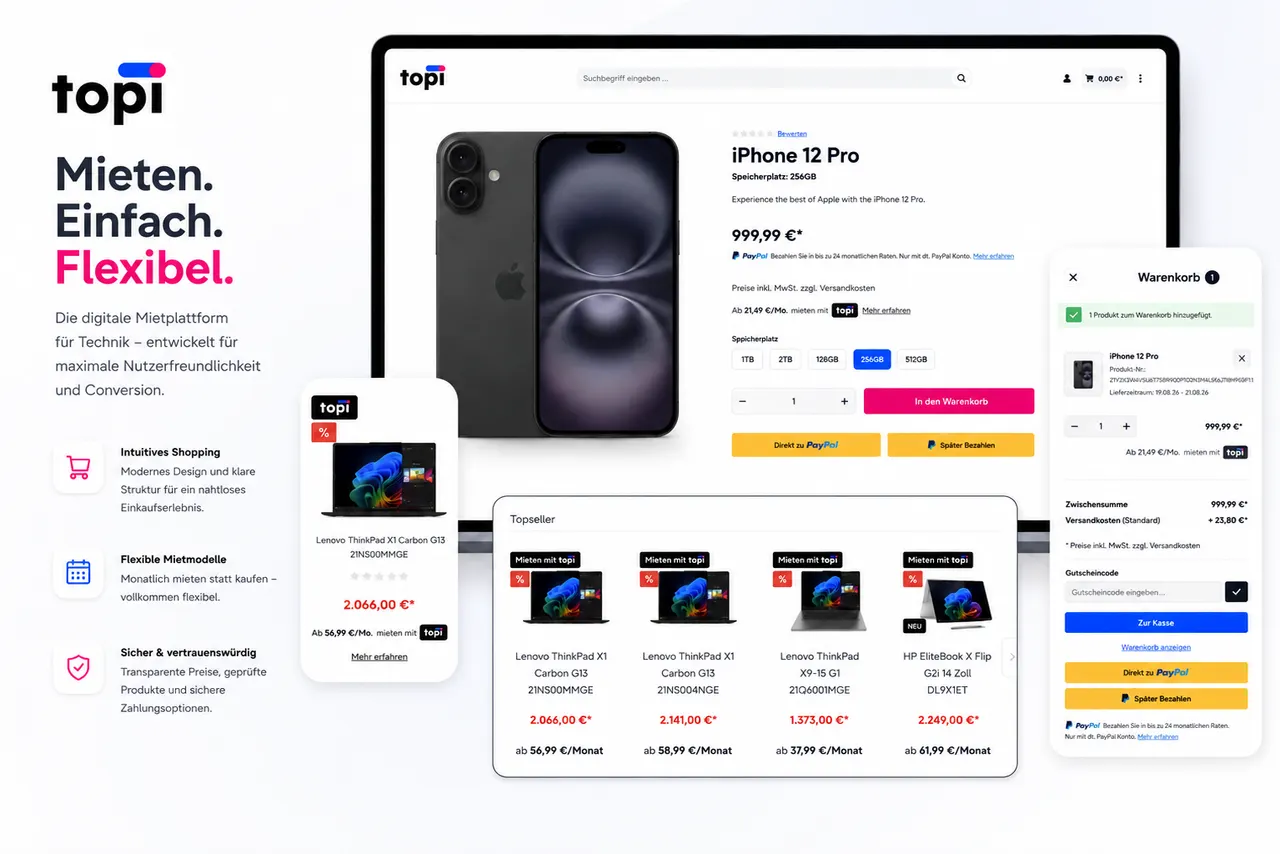
Leasing, financing and B2B rental directly in checkout — from Targo leasing at COMSPOT to the topi rental payment we built as a Shopware plugin for well-known IT retailers.
One system, two worlds
Business customers with their own pricing, quote requests and approvals alongside the B2C consumer business — one product master, separate pricing logic. Shopware 6 handles the hybrid without a second system.
IT retail is our home game.
References from your industry beat any feature list — ours have been running in production for years.
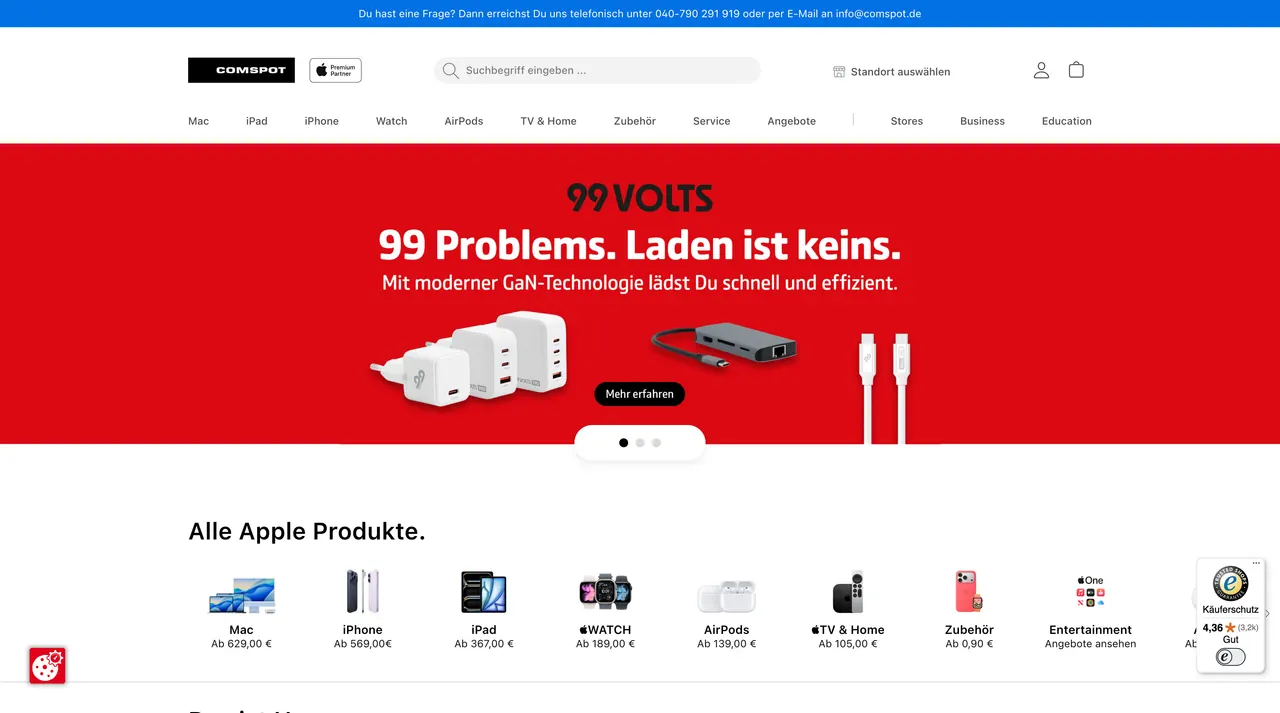
For COMSPOT, one of Germany's largest Apple Premium Resellers, we have operated and developed the shop since 2021 — more than 1,500 work items, from Shopware 5 to 6.7, B2C and B2B on one platform. For topi we built the Shopware integration that brings B2B rental into the checkouts of well-known IT retailers. Both run in production — with processes, integrations and measurable results instead of concept slides. How concrete that gets is shown by the trade-in on COMSPOT's product pages — device buyback at the moment of purchase instead of in a separate portal.
From the industry, for the industry.
 1,500+
Since the 2021 relaunch, nuonic has run and evolved COMSPOT's online shop — from Shopware 5 to 6.7, with more than 1,500 work items across four years.
 ~3 months
nuonic built the Shopware integration that brings topi's B2B rental payment straight into the checkout of well-known ITC retailers. One plugin for many shops.
Electronics retail pays off with a system.
- Dropshipping without own processes, stock or data ownership.
- Replatforming over license costs alone — calculate first, migrate second.
- Projects looking for nothing but the cheapest hourly rate.
- Electronics and IT retailers with seven-figure online revenue.
- Retailers with stores who want to truly connect online and offline.
- B2C retailers with a growing B2B business — or the other way around.
Common questions from electronics retailers.
What does a Shopware shop cost for electronics retailers? +
With ERP integration, store logic or B2B processes, electronics projects typically range from €40,000 to €150,000; simpler setups start at around €25,000. Add operations from roughly €1,000 per month. The honest breakdown of all cost blocks is on our pricing page.
Is Shopware worth it over Shopify with thin margins? +
Especially then. Percentage fees scale with revenue — at high GMV and low margin they eat disproportionately into the result, while the costs of your own Shopware system stay largely fixed. At which revenue the math tips depends on your setup — that's exactly what we calculate with you in the first conversation.
Do we have to buy a Shopware license above €1M GMV? +
No. The Community Edition remains open source and operational above the threshold. Beyond €1M GMV, Shopware requires a commercial plan only for continued use of the Shopware Account and Extension Store. Whether that pays off for your setup depends on the extensions you use — we assess that independently.
Shopware wants a percentage of revenue — unsustainable at our margin. Now what? +
For special economic situations — and low-margin electronics retail explicitly qualifies — Shopware points to individual offers. Low margin therefore belongs early in the conversation with the vendor, not at the end of the negotiation. As an official Shopware partner, we support exactly that negotiation.
Can we run B2C and B2B in one Shopware system? +
Yes. One product master, separate pricing logic, sales channels and experiences — Shopware 6 serves both worlds on one platform. COMSPOT is exactly such a hybrid system from our practice, including business customer processes alongside the consumer business.
Do you support leasing, financing and rental in checkout? +
Yes — in electronics retail that's often the conversion lever, full stop. We integrated Targo leasing at COMSPOT and developed the Shopware plugin for topi that brings B2B rental as a payment method into the checkouts of well-known IT retailers.
Can we take old devices in trade or buy them back? +
Yes. At COMSPOT the trade-in runs right on the product detail page — condition questions, an instant buyback value, payout after inspection. The clean separation is what matters — valuation stays with the buyback partner, commitment and order context stay in Shopware.
We have physical stores — can the shop handle that? +
Yes. Store locator, click & collect, stock display and pickup per location are part of our repertoire — at COMSPOT this omnichannel integration has been running in production for years. The key is stock management in the ERP; we build that integration as the core of the system.
Our shop still works — why talk about the platform now? +
Because the most expensive migration is the rushed one. Whoever opens the platform math before the pressure arrives — Shopware 5 EOL, expiring contracts, the GMV threshold — decides from strength instead of under time pressure. An audit costs a conversation, not a migration.