Shopware vs Shopify in 2026: Which platform fits whom?
Shopware or Shopify? An honest comparison of cost, B2B, customisation, operations and scale, with clear guidance for making the choice.

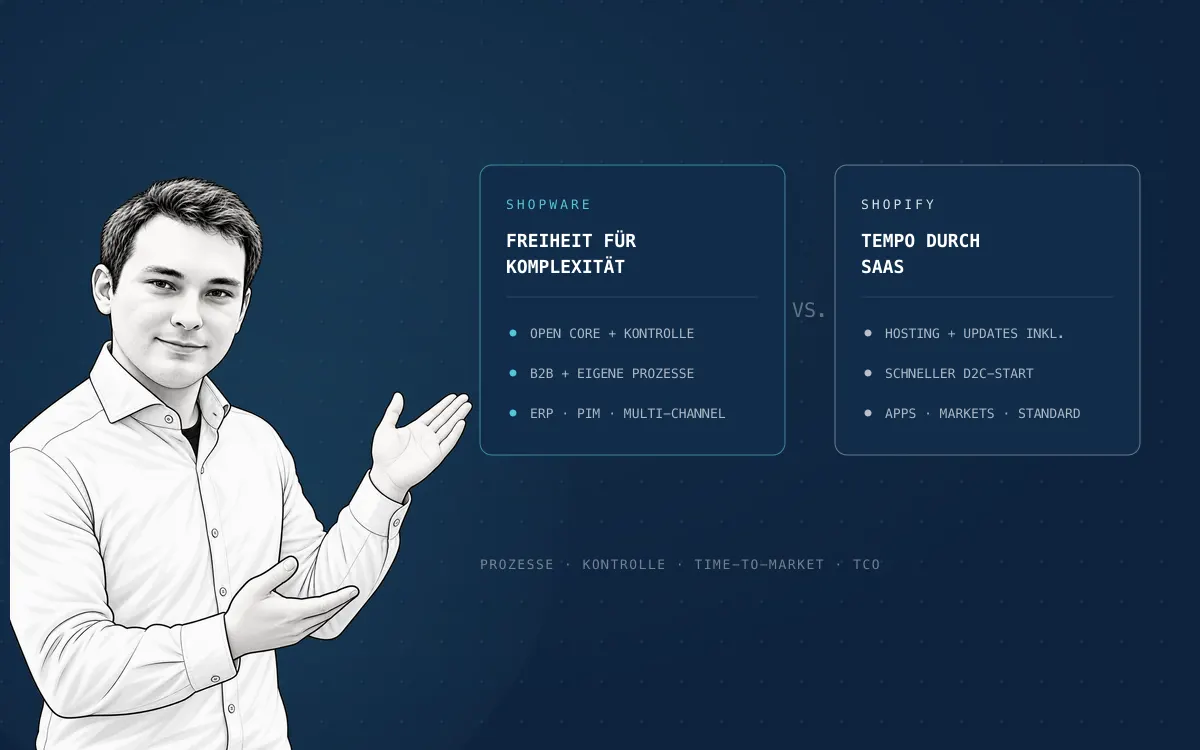
Shopify is often the better choice for a fast, standard-oriented D2C launch with fully managed operations; Shopware for individual business models with complex B2B, deep ERP integrations and custom process logic. A feature checklist misses this most important difference: the two systems represent different platform strategies.
Shopify optimises for a fast start on a largely standardised, vendor-operated commerce stack. Shopware provides more freedom over architecture, data, business logic and operations, but also requires more planning and technical ownership.
That is why Shopify is not simply a platform for small stores, nor is Shopware automatically the superior enterprise solution. The right choice depends on how far the business deviates from standard commerce, which systems need to be integrated and how much control the organisation wants to retain over time.
This comparison reflects the official position on 17 August 2026. Features and prices change, so current vendor information should govern an actual procurement decision.
The short answer: When is each platform better?
Shopify is often the better choice when a brand wants to launch a conventional D2C store quickly, its processes stay close to the platform standard, and hosting, security and updates should be handled almost entirely by the vendor.
Shopware is often the better choice when commerce is a differentiated part of the company's value chain: complex B2B, customer-specific pricing and catalogues, sophisticated ERP processes, multiple business models or unusual checkout, product and fulfilment rules.
The concise version is:
Shopify reduces responsibility for the platform. Shopware increases freedom on the platform.
Either approach can be commercially sound. Problems arise when a business expects the convenience of a managed SaaS product while wanting to rewrite every core process, or buys maximum technical freedom without budgeting for the team needed to operate it.
Shopware and Shopify compared directly
The table sets the ten most important criteria side by side — from the platform model through entry prices (Shopware Community Edition without a licence fee, Rise from €600 per month; Shopify Plus from €2,100 per month on the German pricing page) to the best fit. The price column is deliberately not a verdict: the figures can only be compared together with the complete operating model.
| Criterion | Shopware 6 | Shopify |
|---|---|---|
| Platform model | Open-source core with Community Edition and commercial plans | Proprietary SaaS platform |
| Operations | Self-hosted, Shopware SaaS or PaaS | Hosting and platform operations managed by Shopify |
| Entry point | Community Edition without a licence fee; Rise from €600 per month | Standard plans priced locally; Shopify Plus starts at €2,100 per month on the German pricing page |
| Time to market | More planning with greater architectural freedom | Very fast launch for standard requirements |
| Source and data model | Visible core that can be extended deeply | Extended through themes, apps, APIs, Functions and extensions within platform boundaries |
| Checkout | Deeply adaptable through custom development | Advanced changes to core checkout steps largely reserved for Plus |
| B2B | Strong fit for custom B2B processes; commercial B2B Components from Evolve | Core B2B now available on Basic, Grow, Advanced and Plus; advanced capabilities depend on plan |
| Integrations | Highly flexible for ERP, PIM, OMS and bespoke systems | Large app ecosystem and strong standard integrations |
| International commerce | Sales channels, rules, languages, currencies and bespoke setups | Shopify Markets for a highly standardised international rollout |
| Infrastructure responsibility | Depends on the selected operating model | Included in the subscription |
| Best fit | Complex business models and differentiating processes | Standard-oriented D2C and rapid SaaS operations |
Shopware Community Edition may have a €0 licence fee, but it still needs hosting, maintenance and technical support. Shopify says secure hosting, bandwidth and SSL are included in every subscription on its pricing page. The figures therefore cannot be compared without considering the complete operating model.
The fundamental difference: Product standard or platform control
Shopify is a fully managed SaaS product. Merchants use a centrally operated platform and receive hosting, updates and core security as a service. Customisation happens through defined mechanisms: themes, apps, APIs, Shopify Functions, and checkout or UI extensions. This makes operations predictable and accelerates delivery. It also means Shopify determines which parts can be changed and how far.
Shopware takes a more open approach. Community Edition is available under the MIT licence, and the core can be inspected, self-hosted and modified. The commercial Rise, Evolve and Beyond plans add capabilities and support, while different operating models offer further choice. Shopware describes Community Edition as free and open source on its official download page.
That freedom is valuable when the implementation itself creates competitive advantage. It matters far less when the store simply needs a reliable standard flow for products, cart, checkout and delivery.
Time to market: Shopify's strongest advantage
A conventional D2C project can reach production very quickly on Shopify. Select a theme, import products and configure payment and shipping: much of the stack is ready for standard requirements. Its app ecosystem closes many gaps without a bespoke development project.
Shopware can also launch quickly, particularly with its SaaS option. Its main strength, however, is not forcing every store into the same structure. Sales channels, Rule Builder, Flow Builder and open extensibility create more options, which in turn create more decisions. The data model, integration boundaries and operating model should be designed before development starts.
Shopify is therefore often more economical for a market test with a limited catalogue. For a platform expected to serve several brands, countries, customer groups and back-office processes over many years, Shopware's extra planning can prevent expensive detours later.
B2B: No longer “Shopify Plus only”, but still a key comparison
One common comparison is outdated in 2026: Shopify B2B is no longer limited to Shopify Plus. Companies, catalogues, payment terms, order history and other core capabilities are also available on Basic, Grow and Advanced, according to Shopify's current B2B feature overview.
The plans still differ in depth. According to Shopify, Basic, Grow and Advanced are limited to three active B2B market catalogues, among other restrictions. Unlimited catalogues, direct company catalogues and several advanced B2B capabilities remain Plus features. Contextual storefront experiences and checkout customisation also depend on the plan.
Shopware becomes particularly compelling when B2B is not just an additional price list but the company's operating model:
- multi-level organisations, buyer roles and approval chains,
- customer-specific assortments, prices and visibility,
- quick orders, shopping lists and quotation processes,
- bespoke units, packaging or minimum quantities,
- ERP-managed credit limits, availability and delivery rules,
- parallel B2B, D2C and dealer portals.
How such a project should begin is covered in our checklist for starting a B2B store.
Shopware's commercial B2B Components are included from Evolve. Bespoke needs can additionally be implemented through the open core, plugins and APIs. The official Shopware feature overview lists the capabilities in each plan.
That does not make Shopware automatically cheaper or faster. For complex B2B, however, it is often the more sustainable foundation because business logic can live closer to the platform. Our Shopware B2B page explains the relevant architecture and processes in more detail.
Checkout and business logic: Where standardisation becomes a boundary
Shopify deliberately protects its checkout. That provides a consistent, performant purchasing experience that the vendor can optimise continuously. Basic changes are available on the standard plans, while deeper extensions to the information, shipping and payment steps require Shopify Plus according to the official checkout documentation.
For many merchants, that guardrail is a benefit: the checkout does not need to be revalidated after every platform update. It becomes a constraint when the purchase process itself is unusual, for example:
- quote requests instead of immediate orders,
- configurable or consultation-intensive products,
- bespoke delivery dates and freight rules,
- multiple carts or approval workflows,
- customer-specific payment and tax rules,
- reservations, subscriptions or hybrid service products.
Shopware permits deeper changes to the storefront, checkout, cart and backend logic. This is one of the strongest reasons to select Shopware, provided the freedom is genuinely required and professionally tested. A heavily customised checkout is not a goal in itself; it creates additional responsibility for conversion, upgrades, security and quality assurance.
ERP, PIM and individual system landscapes
Shopify has an extensive app ecosystem. Ready-made integrations often exist for popular marketing, payment, fulfilment and CRM tools. This reduces implementation effort and is attractive when the merchant can align its processes with established SaaS conventions.
Established retail and manufacturing organisations frequently start from a different position. Prices come from an ERP, product data from a PIM, stock from several warehouses, and orders from both EDI and the storefront. Customer accounts may carry years of contract-specific logic. The commerce layer then needs to orchestrate decisions across systems, not merely send orders to a backend.
Shopware provides more room for that orchestration through its open data model, APIs, events, rules and custom plugin logic. This does not automatically make integrations inexpensive. It does make it less likely that a critical process ends at a platform boundary that cannot be changed.
Shopware is especially strong where the ERP does more than receive orders and jointly governs pricing, availability, customer permissions and fulfilment with the storefront.
Internationalisation and multichannel commerce
Shopify Markets provides a convenient way to manage countries, currencies, domains and local experiences centrally. This is a major advantage for brands with a relatively consistent product and process model. According to Shopify, some market-specific checkout configurations are only available on Advanced and Plus.
Shopware uses sales channels, Rule Builder and configurable contexts. This is helpful when countries or brands are not merely translated but operated with different business rules: different assortments, pricing logic, customer groups, ERP companies or fulfilment processes.
The choice therefore depends on what “international” means:
- the same store localised for more markets: Shopify advantage,
- different business logic per market, brand or channel: often a Shopware advantage.
Cost: Compare TCO with TCO, not licence with subscription
Shopware lists Community Edition at €0, Rise from €600 and Evolve from €2,400 per month; Beyond is quoted individually. Shopware says commercial pricing depends on GMV and other factors on its official pricing page.
Shopify offers Basic, Grow, Advanced and Plus. Standard plan prices depend on market and billing interval. At the reference date, the German pricing page lists Plus from €2,100 per month. Using an external payment provider can also trigger an additional Shopify transaction fee; the comparison matrix on Shopify's pricing page currently lists 2%, 1%, 0.6% and 0.2% depending on the plan.
A credible three- to five-year TCO calculation includes the following on both sides:
- plan or licence costs,
- hosting, platform operations and monitoring,
- implementation and migration,
- apps, plugins and external SaaS services,
- integrations and custom development,
- payment and transaction charges,
- upgrades, testing, support and internal teams,
- the cost of a future platform change.
Shopify can be substantially less expensive for standard requirements because so much operational work is bundled. As complexity grows, Plus, multiple paid apps, revenue-related fees and workarounds can narrow the difference.
Shopware usually requires a larger implementation and operating investment. In return, critical processes can be implemented without necessarily moving to a closed enterprise package or assembling a chain of interdependent apps. Shopware is not inherently cheaper, but it can be more predictable for individualised business models. Our Shopware cost guide sets out the complete budget structure, and the Shopware cost calculator supplies the Shopware side of the TCO comparison per basket.
Which businesses are better served by Shopware?
Shopware is the better choice for six profiles: manufacturers and wholesalers with genuine B2B commerce, merchants with complex ERP, PIM or logistics landscapes, companies whose bespoke logic is a competitive advantage, multi-brand and multichannel business models, organisations with sovereignty and operating requirements, and teams with technical capability or a long-term implementation partner. In detail:
1. Manufacturers and wholesalers with genuine B2B commerce
Where organisations, buyer roles, approvals, individual pricing, quotations and ERP processes define daily operations, Shopware often fits better. It can bring the digital portal closer to the existing sales model instead of reducing that model to a standard catalogue.
2. Merchants with complex ERP, PIM or logistics landscapes
Shopware is strong when commerce mediates between several systems of record and needs its own process logic. In established mid-market organisations, legacy ERP and inventory processes are frequently the rule rather than the exception.
3. Companies whose bespoke logic is a competitive advantage
Custom configurators, quotation journeys, price algorithms, delivery models and service products can be integrated deeply into Shopware. A business that differentiates itself through those processes should not reshape them around a platform boundary without careful analysis.
4. Multi-brand, multichannel and hybrid business models
Multiple brands, B2B and D2C, country portals, marketplaces and physical channels can be differentiated through Shopware sales channels and rules. The advantage grows when those channels do not share identical assortments and processes.
5. Organisations with sovereignty and operating requirements
Self-hosting, a specific cloud stack, data location, deployment process or direct access to the core can be strategic requirements. Shopware offers more choice here. Organisations that do not need that control benefit more from Shopify's fully managed operation.
6. Teams with technical capability or a long-term partner
Openness creates value only when architecture, upgrades and quality are managed professionally. Shopware suits companies with an internal commerce team or an implementation partner accountable over the long term. It does not suit the expectation that a highly bespoke system can run indefinitely without a technical budget.
When is Shopify the better choice?
Shopify is probably the better option when a standard-oriented D2C store needs to launch quickly, a small team wants to handle as little platform operation as possible, and the app ecosystem covers the requirements. An honest comparison needs to be explicit about this side as well — Shopify probably fits better when:
- a D2C store or MVP needs to launch in a short period,
- product, pricing, checkout and shipping processes are largely standard,
- a small team wants to handle as little platform operation as possible,
- a ready-made app matters more than deeply integrated custom development,
- Shopify Payments, Markets and the existing ecosystem fit the model,
- technical sovereignty is not a key procurement requirement.
In these cases, Shopware's flexibility might become paid but unused complexity. The best platform is not the one with the most freedom. It is the one whose boundaries fit the business model.
A robust decision process in five steps
Five steps carry the decision: document revenue-critical processes instead of feature lists, weight the requirements, model a three-year TCO, prove the critical assumptions in a proof of concept, and examine exit paths. Teams that follow this order compare real platform boundaries rather than marketing claims.
1. Document processes, not feature lists
Map five to ten revenue-critical journeys end to end: pricing and availability, customer access, checkout, returns and quotations. Real platform boundaries become visible in these processes.
2. Weight the requirements
Score time to market, B2B, integrations, checkout, internationalisation, operations and TCO. One mandatory criterion must not be overruled by ten minor convenience features.
3. Model three-year TCO
Compare more than the first monthly payment. Include realistic platform, extension, payment, implementation, operating and team costs, with expected growth and additional markets.
4. Prove the critical assumption
Do not use the homepage as the proof of concept. Build a small version of the hardest pricing, B2B, checkout or ERP process. It reveals architectural limits earlier than any vendor demo.
5. Examine exit paths and dependencies
Which data can be exported? Which logic lives in apps, plugins or external services? Which capabilities depend on a plan? A potential future move belongs in the calculation from day one.
For an existing platform, the decision should also be based on a migration audit. Our Shopware migration guide explains which data, integrations, SEO signals and operational risks need to be resolved before replatforming.
Conclusion: Shopware wins where individuality has commercial value
Shopify is a strong commerce product for rapid, standard-oriented and vendor-operated retail. Shopware is a strong commerce platform for organisations that want more control over processes, integrations and the operating model.
That makes Shopware particularly well suited to manufacturers, wholesalers, complex B2B organisations, integrated mid-market companies and multichannel businesses. Not because open source is inherently superior, but because these models are more likely to reach the boundaries of a uniform SaaS standard.
Shopify can clearly be the more sensible choice for a young D2C store with standard processes. For an organisation whose pricing logic, customer structure, products and fulfilment create its competitive advantage, Shopware's additional freedom is often the more sustainable investment. The difference is most pronounced at high revenue and thin margins — for instance in electronics and IT retail, where percentage-based fee models eat disproportionately into the result.
Official sources
Let's talk about your system.
No pitch deck. A conversation with the people who build.