Warranty notice vs. GARAN label: the difference — and who has to do what
Two obligations, one deadline, plenty of confusion: what separates the harmonised warranty notice from the GARAN label and which merchant has to implement what by 27 September 2026.

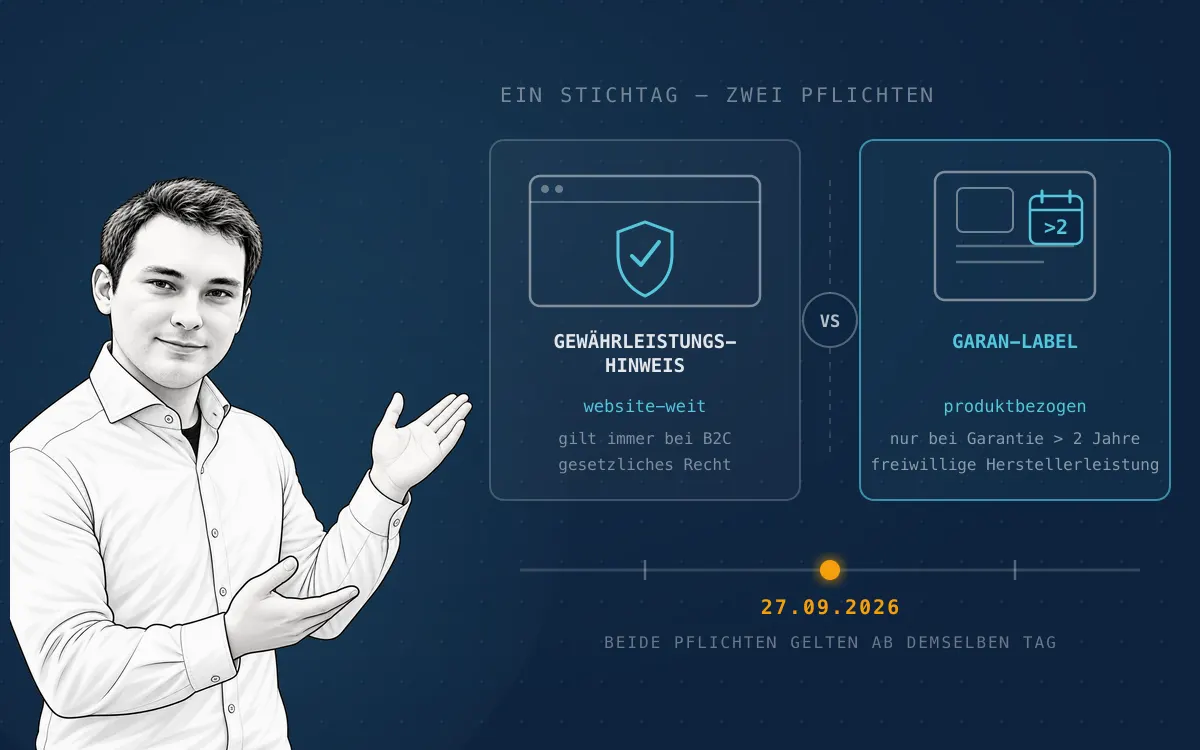
From 27 September 2026, the EmpCo directive (EU) 2024/825 requires B2C shops to display two new markings — and this is exactly where the confusion starts. The harmonised warranty notice and the GARAN label share a deadline, a legal basis and a visual style, but they mean two completely different things: the notice is a site-wide reminder of a right consumers always have. The label marks, per product, a voluntary commitment that only exists for some products. Confusing the two means implementing either too much — or too little, and risking a legal warning. This post puts the two instruments side by side and shows, by merchant type, what concretely needs to be done.
This post provides practical orientation, not legal advice. For special cases – imports, private labels, marketplaces or mixed B2B/B2C models – the concrete implementation should be reviewed legally.
The core difference in one sentence
The warranty notice informs about a law that always applies — the GARAN label marks a promise a manufacturer makes voluntarily. The statutory warranty of at least two years exists in every consumer purchase of goods, whether the shop points it out or not; the notice merely makes it visible. A durability guarantee of more than two years, by contrast, only exists if a manufacturer offers it free of charge for the entire product — and only then may and must the GARAN label appear. It is explicitly not a quality seal you can earn or attach voluntarily.
The two instruments side by side
| Warranty notice | GARAN label | |
|---|---|---|
| What it marks | statutory warranty (min. 2 years) | manufacturer's voluntary durability guarantee |
| Scope | site-wide, product-independent | individual product |
| Trigger | selling goods to consumers | free manufacturer guarantee over 2 years for the whole product |
| Mandatory for | practically every B2C goods shop | only products where such a guarantee exists |
| Content | fixed wording with checkmark symbol | calendar symbol with guarantee duration in years, manufacturer, model |
| Data basis | none — static notice | guarantee duration, manufacturer, manufacturer product number per product |
| Design | EU template, in colour, QR code to "Your Europe" | EU template, in colour, QR code to "Your Europe" |
Appearance, wording and colours of both markings are prescribed by Implementing Regulation (EU) 2025/1960 — custom icons or reworded texts do not fulfil the obligation. The detailed consumer information behind the QR code lives on the EU portal Your Europe.
Who has to consider what?
The impact differs considerably by business model — and so does the workload.
The classic B2C merchant
For every shop selling goods to consumers, the warranty notice is mandatory — with no revenue, size or small-business exemption. The effort is small: embed the EU template, clearly visible, in colour, in every shop language. Whether the GARAN label is needed on top depends solely on the assortment: if you carry no product with a free manufacturer guarantee of more than two years, the notice is all you need. You do not have to actively research such guarantees — but you must display them when you know about them or advertise with them.
Merchants with guarantee-heavy assortments
Electronics, household appliances, tools, furniture: wherever manufacturers advertise long guarantees, the GARAN label becomes a data task. Each affected product needs the guarantee duration, the manufacturer and the manufacturer product number — cleanly modelled from PIM or ERP, not maintained manually item by item. The edge cases matter: a paid guarantee extension does not trigger a label, a guarantee on parts only (say, the motor) does not either, and at exactly two years the rule is: no label — only more than two years counts.
Shops selling food and everyday goods
Food and goods of everyday consumption are exempt from the warranty notice. A pure food shop generally has to implement neither instrument. Mixed assortments — the delicatessen shop that also sells kitchen appliances — need a deliberate delineation of which areas fall under the obligation.
Pure B2B shops
Whoever sells exclusively to businesses is not affected — by either instrument. But the bar is factual, not cosmetic: a freely accessible shop does not become a pure B2B shop through B2B prices or a VAT-ID query alone. If consumers can factually order, the B2C exposure should be reviewed — the same logic as with the withdrawal button.
Mixed B2B/B2C shops
Here the obligation applies to the B2C part. In practice that means configuring the visibility of notice and label per sales channel or customer group, not globally for the whole shop. That is a deliberate architecture decision — and one of the points where implementation is more than ticking a box.
The most common mix-ups
The separation of the two instruments produces the typical mistakes:
- Treating the GARAN label as a quality seal. It does not "decorate" — it only appears when the guarantee conditions are objectively met. A label without an underlying manufacturer guarantee is misleading.
- Embedding the notice per product. The warranty notice belongs site-wide in the B2C storefront, not as a badge on individual articles.
- Using custom icons or texts. Both markings are harmonised — layout, wording and colours are fixed. Creative in-house solutions are not a safe route.
- Labelling paid or partial guarantees. Only the free durability guarantee of more than two years for the entire product counts.
- Delivering the label in black and white. In online retail, both markings must be displayed in colour.
Implementation: both are native in Shopware 6
For Shopware merchants the technical side is solved: from Shopware 6.7.14 and with the backport for the 6.6 line, the core ships both markings — the warranty notice as a checkout setting per sales channel, the GARAN label as a product feature fed by guarantee duration, manufacturer and manufacturer product number (Shopware announcement). The step-by-step implementation, the options for older versions, headless setups and Shopware 5, and the full checklist are covered in detail in our post Warranty label 2026: EmpCo obligation and Shopware 6 implementation.
The larger part of the work is not technical anyway, but data-related: collecting manufacturer guarantees, clarifying edge cases, delineating sales channels. Whoever starts today has no bottleneck at the deadline.
The full picture: compliance 2026/27 in the whitepaper
Warranty notice and GARAN label are two obligations among many in the same window — the withdrawal button, PPWR, CCD II and the Digital Product Passport follow. Our whitepaper bundles all deadlines and recommendations; the roadmap is also available as a post: e-commerce deadlines 2026/27.

Quick check: which obligation applies to you?
- Do you sell goods to consumers? → embed the warranty notice (exception: pure food/everyday-goods assortments).
- Do you carry products with a free manufacturer guarantee of more than two years for the whole product? → additionally the GARAN label per product.
- Do you sell exclusively B2B — factually, too? → neither obligation applies.
- Mixed shop? → configure notice and label deliberately per channel or customer group.
Whether your assortment contains edge cases, your product data supports the label requirements and your shop is on the right version is something we are happy to review together — as part of Shopware support & maintenance.
Sources and further reading
- Directive (EU) 2024/825 (EmpCo) on empowering consumers for the green transition
- Implementing Regulation (EU) 2025/1960: harmonised notice and label
- Shopware: GARAN label and EU warranty – native features in 6.7.14 and 6.6
- IHK Bodensee-Oberschwaben: EmpCo directive 2026 – new labelling obligations
- European Commission: Your Europe – guarantees and returns
- Warranty label 2026: EmpCo obligation and Shopware 6 implementation
Let's talk about your system.
No pitch deck. A conversation with the people who build.