Warranty label 2026: EmpCo obligation and Shopware 6 implementation
From 27 September 2026, the harmonised warranty notice and the GARAN label become mandatory. Who the EmpCo obligation applies to, what needs to be done and how to implement it in Shopware 6.

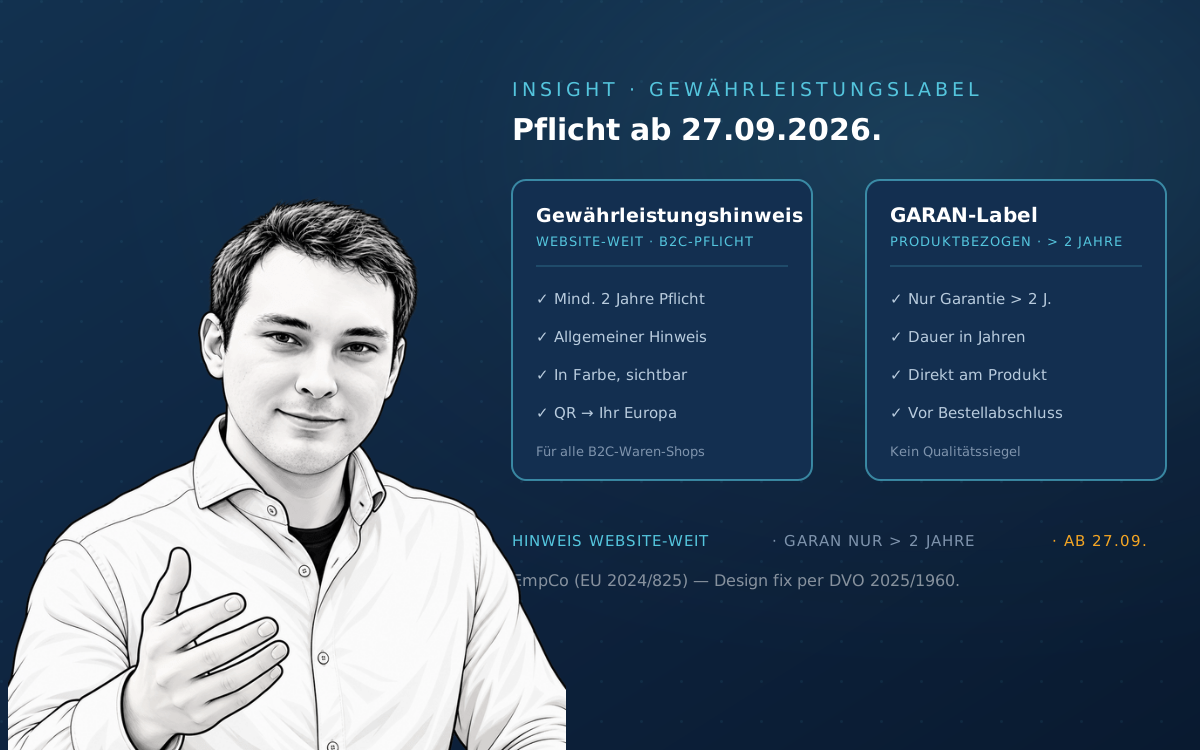
From 27 September 2026, online shops selling goods to consumers must display the harmonised warranty notice in a clearly visible way – and, wherever a manufacturer voluntarily grants a free durability guarantee of more than two years, additionally show the harmonised GARAN label on the product. The legal basis is the EmpCo directive (EU) 2024/825; appearance, wording and colours are prescribed by Implementing Regulation (EU) 2025/1960. Free-form substitute texts or custom icons are not a safe route. Shopware ships both markings natively in the core from version 6.7.14 (early September 2026) and as a backport for the 6.6 line – in every plan, including the Community Edition.
The obligation is frequently misunderstood: it affects almost every B2C goods shop – not just large merchants – but it does not apply to genuinely B2B-only shops. And the notice about the statutory warranty is something different from the product-specific guarantee label. This article puts both in context and shows the practical path for Shopware 6. For the full regulatory roadmap, see our e-commerce deadlines for 2026/27.
This article provides technical and practical guidance, not legal advice. Special cases – such as imports, private labels, marketplaces, mixed B2B/B2C models or sustainability claims – should be legally assessed for the individual setup.
Warranty notice or GARAN label – which is which?
The EmpCo directive introduces two separate but related instruments. Confusing them means implementing either too much or too little. The detailed comparison with the obligations by merchant type is covered in our post Warranty notice vs. GARAN label.
- The harmonised warranty notice is a general reminder of the statutory warranty of at least two years. It applies site-wide to the B2C presence, independent of any individual product.
- The harmonised durability-guarantee label (“GARAN label”) is product-specific. It only comes into play when a manufacturer offers a free durability guarantee of more than two years for the entire product and provides that information. It is not a general quality seal or trust mark.
Both are designed uniformly across the EU: fixed wording, fixed symbols – a check mark for the warranty, a calendar with the guarantee duration in years – plus a QR code or link to the EU portal “Your Europe” with the detailed consumer information. In online retail, both must be displayed in colour.
Who does the directive apply to?
The basic rule: every business selling goods to consumers is affected – online and in-store alike. For the warranty notice there is no turnover, size or small-business exemption. A one-person shop with a B2C assortment is just as affected as an international merchant.
At its core, two groups are exempt: food and everyday consumer goods on the one hand, and genuinely B2B-only sales on the other. The GARAN label, in turn, is only mandatory where a manufacturer guarantee of more than two years actually exists – the merchant does not have to actively research such guarantees, but must display them where they are known or advertised.
| Scenario | Warranty notice | GARAN label | Why |
|---|---|---|---|
| B2C goods shop | usually yes | only for guarantees > 2 years | Sale of goods to consumers |
| Shop selling only food / everyday goods | usually no | no | Expressly exempt |
| Genuine B2B-only shop | no | no | No sales to consumers |
| Mixed B2B/B2C shop | yes, for the B2C part | proportionately | The consumer share is covered |
| Product with manufacturer guarantee ≤ 2 years | yes | no | Label only above two years |
As with the withdrawal button, the same principle applies: a freely accessible shop does not become a B2B-only shop merely through B2B pricing or a VAT-ID field. If consumers can in fact order, the B2C position should be checked.
When does the obligation apply?
The key dates are set:
- 26 March 2024: The EmpCo directive (EU) 2024/825 enters into force.
- 25 September 2025: Implementing Regulation (EU) 2025/1960 fixes the design, wording and format of the notice and label.
- 27 September 2026: The national implementing provisions apply. From this date, the notice – and, where relevant, the label – must be live in the shop.
Important: there are no transition rules for goods already produced or for existing shops. 27 September 2026 is not a soft target but the day the correct state must be live in production. The remaining time is an implementation phase, not a preparation phase.
What are the concrete steps?
The effort is manageable if approached in a structured way. The order:
1. Classify your assortment and exposure
First clarify which sales channels and customer groups are B2C, whether exemptions (food, everyday goods) apply and where genuine B2B business exists. For mixed shops, the visibility of notice and label is a deliberate configuration per channel or customer group – not a cosmetic setting.
2. Add the warranty notice site-wide
The harmonised notice must be integrated into the B2C presence clearly visibly and in colour – as a general reminder, not product-specific. Use the official templates from the European Commission with the prescribed layout and the QR code linking to “Your Europe”. Custom wording does not replace the harmonised notice.
3. Collect manufacturer guarantees
Determine for which products a free durability guarantee of more than two years exists for the entire product. This information comes from the manufacturer and belongs cleanly modelled as product data – ideally from PIM or ERP, not as manual one-by-one maintenance in the catalogue.
4. Display the GARAN label per product
Where such a guarantee exists, show the GARAN label directly with the product, with the guarantee duration in years. Online, a nested display is permitted – a compact symbol that expands on click or mouseover. The notice must also be accessible before the order is completed.
5. Review green claims in parallel
EmpCo simultaneously tightens the rules for environmental claims. Generic claims such as “environmentally friendly”, “climate neutral” or “green” need a robust basis from the same date – or must be removed from product data, banners, filters and campaigns. This belongs in the same implementation wave.
6. Test multilingual and mobile
Both elements must appear correctly in every relevant shop language, on mobile devices and for guest orders. Also verify that the QR code leads to the right portal and that the assets are delivered in colour.
How can this be implemented in Shopware 6?
Good news: as with the withdrawal button, Shopware ships both the warranty notice and the GARAN label natively in the core. With Shopware 6.7.14 (available in early September 2026) and a backport for the 6.6 line, both markings are available in every plan – including the Community Edition. For standard storefronts, a custom build is therefore usually no longer necessary. For the technical context of the release line, see Shopware 6.7: new features and update benefits.
What the native feature actually does. It consists of two separate building blocks that Shopware integrates directly into the storefront:
- Statutory warranty notice: a product-independent, standardised notice. Shopware shows it on the order confirmation page next to the terms checkbox; a link opens the full text in a modal referring to the European Commission. It is enabled and disabled under Settings → Cart → Checkout, can be overridden per sales channel, and Shopware automatically picks the matching language from the 24 official EU languages.
- GARAN label: product-specific. It appears below the buy box as a compact preview that opens the full label on click, and additionally in the cart and on the order confirmation page. It shows the manufacturer brand, model identifier and guarantee duration, with a fixed QR code to the EU consumer portal. The label is only displayed once all prerequisites are met: a manufacturer guarantee of more than two years, a maintained manufacturer and a manufacturer product number, plus the storefront toggle enabled.
The route with the native feature:
- Plan the update: upgrade to Shopware 6.7.14 or use the backport for the 6.6 line. With a custom theme or headless frontend, the display may require a deliberate adjustment.
- Prepare now: identify products with a free manufacturer guarantee of more than two years, obtain the guarantee terms from the manufacturers and have the arrangement reviewed legally. This is independent of the update and the larger part of the work.
- Enable and maintain: switch on the warranty notice in the checkout settings (per sales channel). For the label, enter the manufacturer guarantee duration in months in a new card on the product detail page and enable “Show label in the storefront”; the label pulls manufacturer and manufacturer product number from the existing product data. For large catalogues, importing from PIM or ERP beats manual per-item maintenance.
- Test the storefront: the notice on the order confirmation, the label below the buy box, in the cart and on the order confirmation – per language, on mobile and as a guest, with particular care on custom themes.
Shopware explicitly notes that legal compliance and the correctness of the product data remain the merchant’s responsibility. Shopware describes the native implementation in its article GARAN label and EU warranty.
Older versions, headless and custom frontends
Anyone who cannot upgrade to 6.7.14 or the 6.6 backport – or who runs a headless setup – still needs their own route: a specialised plugin or a targeted theme and data integration. The Shopware Store offers plugins that deliver the notice and GARAN label with central admin configuration, automatic language handling and custom fields. Alternatively you model the logic yourself: a numeric field for the manufacturer-guarantee duration per product, a Twig condition on the product detail page (label from more than 24 months, otherwise only the notice) and the official EU label assets in the theme. With custom frontends, this is a topic for Shopware development, not just the administration.
What are the options for Shopware 5?
For Shopware 5, the same legal obligation applies – the technology is the bottleneck. Shopware 5 has been end-of-life since July 2024, so it receives no further development from the core. Three options remain:
- A plugin as an interim measure: extensions exist for Shopware 5 that cover the notice and label. This can bridge a deadline, but it is no state for permanent operation on a discontinued platform.
- Custom template adjustments: technically possible, but they tie budget to a platform that is at the end of its support life anyway.
- Migration to Shopware 6: the sustainable route. Compliance topics like this one arrive quarterly; on Shopware 6, many of them come straight from the core – the warranty notice and GARAN label are exactly such a case with 6.7.14 and the 6.6 backport.
We assess the risks and options of continued operation in our Shopware 5 EOL article; whether and how a switch pays off is covered in Shopware migration: you don't have to move to Shopware 6 – but here is what you lose. For the concrete process, see our Shopware 6 migration page.
The full picture: compliance 2026/27 in our whitepaper
The warranty label is only one deadline of many. The withdrawal button, PPWR, CCD II, the Cyber Resilience Act and the Digital Product Passport follow in the same window. Our whitepaper puts all deadlines in order, delimits who is affected and provides the recommendations to act on:

Checklist before 27 September 2026
- Is it clear which channels are B2C and where exemptions (food, everyday goods, genuine B2B) apply?
- Is the shop updated to Shopware 6.7.14 or the 6.6 backport so the native feature is available?
- Is the harmonised warranty notice in place site-wide, in colour and with a working QR target?
- Are the products with manufacturer guarantees above two years recorded – from PIM/ERP instead of manually?
- Are the manufacturer and manufacturer product number maintained per affected product and the GARAN display enabled?
- Does the GARAN label appear only there, with the correct duration in years, and is it accessible before the order is completed?
- Are only the official EU templates used instead of custom icons or substitute texts?
- Have generic green claims (“environmentally friendly”, “climate neutral”) been reviewed or removed?
- Does everything work per language, on mobile and for guest orders?
The warranty label is not a major commerce project, but it is an obligation with a hard deadline and a prescribed design. Thinking about the data model, template and manufacturer guarantees together gets it done cleanly in one go. For implementation, updates and continuous checks, our Shopware support team can help.
Sources and further information
- Directive (EU) 2024/825 (EmpCo) on empowering consumers for the green transition
- Implementing Regulation (EU) 2025/1960: harmonised notice and label
- Shopware: GARAN label and EU warranty – native features in 6.7.14 and 6.6
- Noerr: new labelling obligations for manufacturer guarantees and warranty rights
- IHK Bodensee-Oberschwaben: EmpCo directive 2026 – new labelling obligations
- Shopbetreiber-Blog: new labelling of warranty rights and durability guarantees
- mdc: EU guarantee labels 2026 – technical implementation in Shopware 6
- Shopware Store: unified EU label for warranty and guarantee
- Shopware Store: EU warranty label and guarantee label (GARAN)
- WEB-Grips: new EU warranty label from 27 September 2026 for Shopware
- XICTRON: implementing the warranty-notice obligation in Shopware
- BOEHMERT & BOEHMERT: EmpCo directive (EU) 2024/825 – what is it about?
- IANEO: EmpCo directive – obligations for online shops from 2026
- European Commission: “Your Europe” – guarantees and returns
Let's talk about your system.
No pitch deck. A conversation with the people who build.